AstroBin is the home of astrophotography - Share full resolution images, preserve acquisition details, discover equipment, discuss techniques, and learn from the community.Discover AstroBin

Isolating extragalactic stars

Alan BrunelleTony GondolaAnaTaDon Woelz
51 replies1.3k views
Alan Brunelle avatar

Don Woelz · May 21, 2026, 04:42 PM

To image a star in M31, the closest galaxy to us, you would need a telescope capable of 0.1 to 0.3 arcsec resolution. You are probably not seeing individual stars, only clusters or bright reflection nebulae being illuminated by star clusters. And magnitude is not a measure of distance unless you know the intrinsic brightness of the star. The only star you are likely to see in a remote galaxy with most amateur equipment is a supernova.

M31 is not a remote galaxy.

If I said I could resolve stars (maybe misinterpreted as resolving the dimensions of “a” star) with the data, that is incorrect. No one, even most telescopes in professional service cannot resolve a star, even in our own galaxy. What I mean is being able to separate stars, or seeing the light of a star. It is a rare telescope that has directly imaged even a planet around a star. GAIA is not that large a telescope. I doubt that it can resolve at the level you insist are necessary. yet it includes within its reported stars, plenty of stars that are at and around M31.

What resolution means with most star discussion typically is referring to the separation of two stellar (i.e. point-like) sources. So my bad for conflating those two. But in typical discussions, this is not an uncommon use for what we are discussing.

As I said above, I do not need to argue the point of the data I have. I have already stated that I did look at specific regions of the image from the RASA 36 where the objects were well enough separated so that I could confirm without a doubt that I could see stars and patterns of stars that were visible in images from very large aperature telescopes. This argument is for those “field” stars, which in this case only means the stars that create the image of the outline and outskirts of M31, whether resolved or not in all images of M31. Certainly, the RASA is not seeing any red dwarf stars, which most of us can hardly detect for red dwarfs within the Milky Way.

Your last sentence highlights exactly my point. Even at large distances, the brightness of the SN makes it obviously visible, regardless that the object is impossible to resolve. Depending on the optic, it certainly can be resolved from closely associated structures of the host galaxy. Depending on the aperature of the telescope, what those resolutions are will be different, but that does not mean the SN is resolved in a true sense. The arcsec resolution of the optic for every single telescope ever used could not ever resolve the dimension of a star at some distance, such as 100 MLy, etc. for example. But the SN can easily be placed within the structures of the galaxy by many amateur telescopes (aside from the fact that all our images are line-of-sight).

Because no star’s dimensions can be resolved, even at the arcsec resolutions you state, then I suppose you are right, no stars can be resolved in even M31. Yet GAIA lists plenty of stars in M31, etc. Also, recall that Cephied Variables were individually studied in M31 and other galaxies using the 100 inch telescope, which these days is in the class of telescopes some “amateurs” are using. Were these resolved? Not by your definition. I have seen images of these plates and I can assure you that I could see many other stars as well.
Don Woelz avatar

AnaTa, I agree that your 250mm scope can resolve a star in NGC 206. The question was originally about stars in other galaxies. I used M31 because if it is very difficult to image individual stars there, the problem escalates quickly when trying to do it with a more distant galaxy. I imaged NGC 206 last year with a setup similar to Tony’s (6” reflector with 585 sensor) and was wondering if I had resolved individual stars. I did some research at the time and decided that I had probably not. I consulted Grok after posting my first reply above to see what it had to say on the topic. I can see I was not totally correct, but not too far off.

For anyone interested, here is what Grok has to say on the subject of imaging stars in M31:

Resolving (i.e., clearly separating as distinct point sources) individual stars in M31 with amateur astrophotography equipment is extremely challenging and limited to the brightest supergiants or stars in less-crowded regions like the star cloud NGC 206. Most amateur images of M31 show the galaxy as a hazy, structured disk with star-like points that are often blends, clusters, or foreground Milky Way stars rather than cleanly isolated M31 members.

Key Requirements

True resolution of individual M31 stars (angular separation ~0.1–0.4 arcseconds in typical regions) demands excellent angular resolution, fine pixel sampling, and long exposures under good conditions. Atmospheric seeing usually limits ground-based amateurs to ~1–2" effective resolution, far coarser than Hubble's ~0.05–0.1".

Minimum practical setup for marginal success (brightest stars in NGC 206 or similar associations):

  • Telescope: 8–12+ inch (200–300+ mm) aperture, preferably a high-quality refractor (APO), Newtonian, or Schmidt-Cassegrain with good optics for resolution. Longer focal lengths (e.g., 1–2+ meters) help with magnification and sampling, but must be well-collimated and thermally stable. Larger apertures (14–24 inch) make it easier visually and photographically for brighter targets.

  • Camera: Cooled monochrome CCD or CMOS (e.g., ZWO ASI series, QHY) with small pixels (ideally ~2–4 μm) for fine sampling. Narrowband or luminance filters help with contrast. Color cameras work but are less optimal for faint detail.

  • Mount and Guiding: Very stable equatorial mount with accurate tracking/guiding (PEC + auto-guiding) for long exposures (minutes to hours total integration). Poor tracking ruins resolution.

  • Pixel Scale: Aim for ~0.2–0.5"/pixel or better to properly sample the seeing disk and stellar separations. Oversampling (finer) is better if seeing allows.

  • Conditions: Dark skies (Bortle 4 or better), excellent seeing (<1.5"), steady atmosphere. Multiple nights of data stacking. High-resolution lucky imaging or short exposures can help beat seeing.

Examples of Amateur Achievements:

  • Some imagers report resolving hints of blue giants/supergiants in NGC 206 with 5–8 inch APOs under exceptional conditions, but results are marginal and require zooming into full-resolution files.

  • Visual observers with 10–15 inch scopes have identified specific ~15–16th magnitude stars in NGC 206.

  • High-end amateur setups (e.g., 10–16 inch scopes + modern CMOS + many hours integration) can show star-like points and partial resolution in dense associations, but crowding and background light from the galaxy make clean isolation difficult.

Practical Limitations

  • Most amateur M31 images (even impressive ones with small refractors or DSLRs) do not resolve true individual M31 stars across the disk—they capture the overall structure, dust lanes, and clusters.

  • Seeing, diffraction limits, and stellar crowding mean that for general disk stars, professional instruments (Hubble, large ground-based with AO) are required.

  • Supernovae in M31 are much easier and have been imaged/photographed by amateurs with modest equipment.

In summary, a high-quality 10–16 inch telescope + cooled high-resolution camera + excellent tracking under top-tier skies gives the best shot at the brightest individual stars in favorable regions like NGC 206. Smaller setups can capture beautiful galaxy images but won't truly resolve single stars. Patience with long integrations and careful processing are essential.

Well written Helpful Engaging
Alan Brunelle avatar

Tony Gondola · May 21, 2026, 05:17 PM

John Hayes · May 21, 2026, 03:11 PM

Putting aside why you want to do this, here’s the approach I would use to mask out the brightest stars.

1) Apply SXT to create a stars only image

2) Use MMT to filter out the smallest stars leaving only the larger stars.

3) Use PixelMath to subtract the large stars from the stars only image.

4) Use PixelMath to screen the stars back into the object only image.

I’m leaving out a few details that might be sticky but in general, this sort of approach should work.

John

Honest answer is that it’s been such a long run of cloudy weather here in Oklahoma, I’m suffering from processing withdrawal.

Just started thinking if there was way a way to just remove just the stars that are part of our Galaxy from an old image of M33 I had. Here’s what I get when doing a star subtraction based solely on size. Mouse over to see original and star reduced versions.

https://app.astrobin.com/i/2u80zg?r=E

Of course, not being based on catalog data it’s not going to be perfect. Also, finding the right maximum star size needs to be refined. Some star like objects that should be there have been removed so that needs some work. anyway, it’s a fun exercise for a cloudy afternoon.

Tony,

It looks like a good attempt. With M33, you should be able to double check on Simbad, etc. if those sars from your process included in the final image are co-local to listed stars for M33. Some may well be so listed and identified as M33 stars. Sadly, not all are, hence some of the issues that come along with this sort of thing.

As for why you should want to do this sort of thing, you can gather from my responses that this is a great idea. (I hope no one, especially John Hayes, does not take my following comments negatively. I do recognize that he did not actually say anything critically about doing what you want to do.) But from my personal experience, while most people are “polite” to my efforts, most really, simple cannot agree with the approach.

To your wonderfully stated reason, I commend you! “Hey, I just want to see what this galaxy actually looks like without all the damn MW stars conflicting my seeing and and my full understanding of this remote object.” For me, this hobby was and is a means of exploration. Never let anyone tell you that doing something different than the masses is a no no, or inappropriate. Never mind that most might not like what you post on occasion. There are no Astrophoto Police to arrest you.

More reasons to preserve visible (telescopically/photographically) stars (or other objects, such as globular clusters, etc.) in remote targets.

  1. Even if the intent of the photographer is to present a “traditional” view of something like M33, or M31, etc., but intends to do a partial star reduction on the final presentation, I argue that the star reduction that affects the stars in M33 should be carefully avoided to preserve the full stellar intensity of stars that are part of the target and not part of the MW. So your image that you linked, is a great start to doing so. For all my similar images (i.e., galaxies and galaxy clusters), I do so now, even if stars are not visible in the targets. This is because StarXT removes much too many of the distant galaxies and clusters and even removes clearly obvious galaxies and sometimes galaxy cores, etc. I see too many images now where the processor posts an otherwise fine image but were too lazy to go back and repair SXT damage.

  2. My personal reason, in addition to your’s and 1 above (maybe redundant, actually) are because I want to see what the Universe looks like without the interference of me being buried within the envelope of the Milky Way. Yes, the stars are pretty and colorful. When I post an image where the MW stars are all removed, I always also post in my revisions a “traditional”, starred image. If I use star reduction, non of that process affects the stars, or star-like features within the galaxies I am presenting. That traditional image can go into the collection of 20,000+ exact same images of any of those objects that exist in the AstroBin archives. But it is the MW star-free image that I spend hours perusing and imaging what it would be like to travel to these far-off places.

  3. To the point in number 2, when I make visual maps of regions like M31 or the Virgo Cluster, the MW local stars are an actual interference with the understanding of map I am trying to convey. To state directly, there are no stars from the Milky Way that have anything to do whatsoever with the targets like M31 and more distant galaxy clusters. If we could travel a few hundred thousand Ly in a straight line toward any of the targets discussed in this thread, the views of those targest would not change perceptible, really one bit, except for the fact that the foreground stars would not be there. So to understand the layout of globular clusters around M31 or M86, etc. the local stars really mess that presentation up. Yes, I could circle every GC (and I have done that as well), but that also effects the perception of what is real.

Alan Brunelle avatar

Don Woelz · May 21, 2026, 05:50 PM

AnaTa, I agree that your 250mm scope can resolve a star in NGC 206. The question was originally about stars in other galaxies. I used M31 because if it is very difficult to image

I don’t understand, NGC 206 is in M31, another galaxy that is 2MLy distant.

Grok mostly makes the points I and others here are making. The issue of crowding was always an issue for this conversation and my statements of seeing field stars was always limited to those regions away from the denser areas of the galaxies discussed and stated multiple times. A RASA 36 is a 14 inch instrument, the upper end of Grok’s examples. And once again, I checked my data against that of the likes of much larger, capable telescopes. Might have done so with the Hubble data, just not sure. I do not want to have to go back and check to prove my point. I never said that my RASA 36 images had field stars that were resolved into tiny points. I just said that I could match patterns to those images that had such resolution. And that M31 and M110 outskirts had a granularity that clearly point to the image being on the cusp of that capability. For me, seeing data that showed there to be a real granularity to such objects, other than have their starfields look just like smooth emissions is a big deal and a big difference in the perception of what a galaxy is from viewing photographs

Don Woelz avatar

Alan Brunelle · May 21, 2026, 06:24 PM

… I never said that my RASA 36 images had field stars that were resolved into tiny points. I just said that I could match patterns to those images that had such resolution. And that M31 and M110 outskirts had a granularity that clearly point to the image being on the cusp of that capability. For me, seeing data that showed there to be a real granularity to such objects, other than have their starfields look just like smooth emissions is a big deal and a big difference in the perception of what a galaxy is from viewing photographs

Sorry Alan, I was responding to a comment by AnaTa. I had not read your post and was not responding to it. I forgot to quote his comment.

Don

Respectful
Tony Gondola avatar

Alan Brunelle · May 21, 2026, 06:06 PM

Tony Gondola · May 21, 2026, 05:17 PM

John Hayes · May 21, 2026, 03:11 PM

Putting aside why you want to do this, here’s the approach I would use to mask out the brightest stars.

1) Apply SXT to create a stars only image

2) Use MMT to filter out the smallest stars leaving only the larger stars.

3) Use PixelMath to subtract the large stars from the stars only image.

4) Use PixelMath to screen the stars back into the object only image.

I’m leaving out a few details that might be sticky but in general, this sort of approach should work.

John

Honest answer is that it’s been such a long run of cloudy weather here in Oklahoma, I’m suffering from processing withdrawal.

Just started thinking if there was way a way to just remove just the stars that are part of our Galaxy from an old image of M33 I had. Here’s what I get when doing a star subtraction based solely on size. Mouse over to see original and star reduced versions.

https://app.astrobin.com/i/2u80zg?r=E

Of course, not being based on catalog data it’s not going to be perfect. Also, finding the right maximum star size needs to be refined. Some star like objects that should be there have been removed so that needs some work. anyway, it’s a fun exercise for a cloudy afternoon.

Tony,

It looks like a good attempt. With M33, you should be able to double check on Simbad, etc. if those sars from your process included in the final image are co-local to listed stars for M33. Some may well be so listed and identified as M33 stars. Sadly, not all are, hence some of the issues that come along with this sort of thing.

As for why you should want to do this sort of thing, you can gather from my responses that this is a great idea. (I hope no one, especially John Hayes, does not take my following comments negatively. I do recognize that he did not actually say anything critically about doing what you want to do.) But from my personal experience, while most people are “polite” to my efforts, most really, simple cannot agree with the approach.

To your wonderfully stated reason, I commend you! “Hey, I just want to see what this galaxy actually looks like without all the damn MW stars conflicting my seeing and and my full understanding of this remote object.” For me, this hobby was and is a means of exploration. Never let anyone tell you that doing something different than the masses is a no no, or inappropriate. Never mind that most might not like what you post on occasion. There are no Astrophoto Police to arrest you.

More reasons to preserve visible (telescopically/photographically) stars (or other objects, such as globular clusters, etc.) in remote targets.

  1. Even if the intent of the photographer is to present a “traditional” view of something like M33, or M31, etc., but intends to do a partial star reduction on the final presentation, I argue that the star reduction that affects the stars in M33 should be carefully avoided to preserve the full stellar intensity of stars that are part of the target and not part of the MW. So your image that you linked, is a great start to doing so. For all my similar images (i.e., galaxies and galaxy clusters), I do so now, even if stars are not visible in the targets. This is because StarXT removes much too many of the distant galaxies and clusters and even removes clearly obvious galaxies and sometimes galaxy cores, etc. I see too many images now where the processor posts an otherwise fine image but were too lazy to go back and repair SXT damage.

  2. My personal reason, in addition to your’s and 1 above (maybe redundant, actually) are because I want to see what the Universe looks like without the interference of me being buried within the envelope of the Milky Way. Yes, the stars are pretty and colorful. When I post an image where the MW stars are all removed, I always also post in my revisions a “traditional”, starred image. If I use star reduction, non of that process affects the stars, or star-like features within the galaxies I am presenting. That traditional image can go into the collection of 20,000+ exact same images of any of those objects that exist in the AstroBin archives. But it is the MW star-free image that I spend hours perusing and imaging what it would be like to travel to these far-off places.

  3. To the point in number 2, when I make visual maps of regions like M31 or the Virgo Cluster, the MW local stars are an actual interference with the understanding of map I am trying to convey. To state directly, there are no stars from the Milky Way that have anything to do whatsoever with the targets like M31 and more distant galaxy clusters. If we could travel a few hundred thousand Ly in a straight line toward any of the targets discussed in this thread, the views of those targest would not change perceptible, really one bit, except for the fact that the foreground stars would not be there. So to understand the layout of globular clusters around M31 or M86, etc. the local stars really mess that presentation up. Yes, I could circle every GC (and I have done that as well), but that also effects the perception of what is real.

I agree, glad you understand what I’m trying to do.

Alan Brunelle avatar

Don Woelz · May 21, 2026, 06:36 PM

Alan Brunelle · May 21, 2026, 06:24 PM

… I never said that my RASA 36 images had field stars that were resolved into tiny points. I just said that I could match patterns to those images that had such resolution. And that M31 and M110 outskirts had a granularity that clearly point to the image being on the cusp of that capability. For me, seeing data that showed there to be a real granularity to such objects, other than have their starfields look just like smooth emissions is a big deal and a big difference in the perception of what a galaxy is from viewing photographs

Sorry Alan, I was responding to a comment by AnaTa. I had not read your post and was not responding to it. I forgot to quote his comment.

Don

No harm taken Don. I just wanted to clarify, knowing that I can often be obtuse when I respond to these threads. I also find that often people do not read the full threads (and who can blame anyone), so repeating and stressing points is useful, even if it seems like I am being “loud”!

This part of the thread seems to be moving a bit off-topic, but may be relevant because resolution by an optic can affect how something like SXT actually works. And SXT would likely play a central role in any star removal for this type of project.

I got to sit down at my computer for the first time in months to look at this astro stuff. I have been taking a hiatus of all things astro, other than browsing. And I am comparing my RASA 14 inch data (reminder that this is purchased data from Hellas-Sky), to images from SDSS9 and Hubble. I stand by my comments, and may put together a bit of a A/V presentation if I can find the time. While it is not a lot of field stars that I can point to in my data, the patterns in the granularity tells me that the RASA 14 inch is right on the cusp, can certainly see some stars (probably brightness and separation being the key), but, as I said, the striking similarity to the patterns (like fingerprints) in what looks like granularity in my data to the SDSS is clear and even extends to patterns in the Hubble image. SDSS is a 2.5 meter scope, or ~100 inches. Hubble is 2.4 M. As some say, seeing is pretty much everything!

Alan Brunelle avatar

With the discussions here about removing stars from images of objects that are well beyond the Milky Way, I brought up the challenge that I ran into with data from a large aperature RASA, which to my surprise appeared to show stars in an around M31, M110, etc. that would normally be considered “field” stars and not just the supergiants, any number of which are visible, depending on the optic used. My desire to remove Milky Way stars from this image were confounded by the fact that millions of faint stars, or should we call them incipient stars, made the task impossible for me with my old techniques. The discussion devolved a bit because of disagreements as to whether stars can really be seen at the distance of M31. I recall, that at the time I too was skeptical as to what I was seeing, so I explored what these incipient stars were. Broadly, it seemed plainly obvious to me that these were indeed stars, only affected negatively affected by the relatively coarse pixel grain expected at this image scale and also by the fact that galactic stars in a dense field are certainly going to suffer from overlap. This indeed is the case, and the granularity of my image goes away as I move in toward the very dense central cores of the galaxies. I repeated basically the way I convinced myself that the RASA 36 was seeing granularity tied closely to the presence of field stars. So I am going to try to post below the sort of thing that convinced me. It is ok if you still disagree with me!

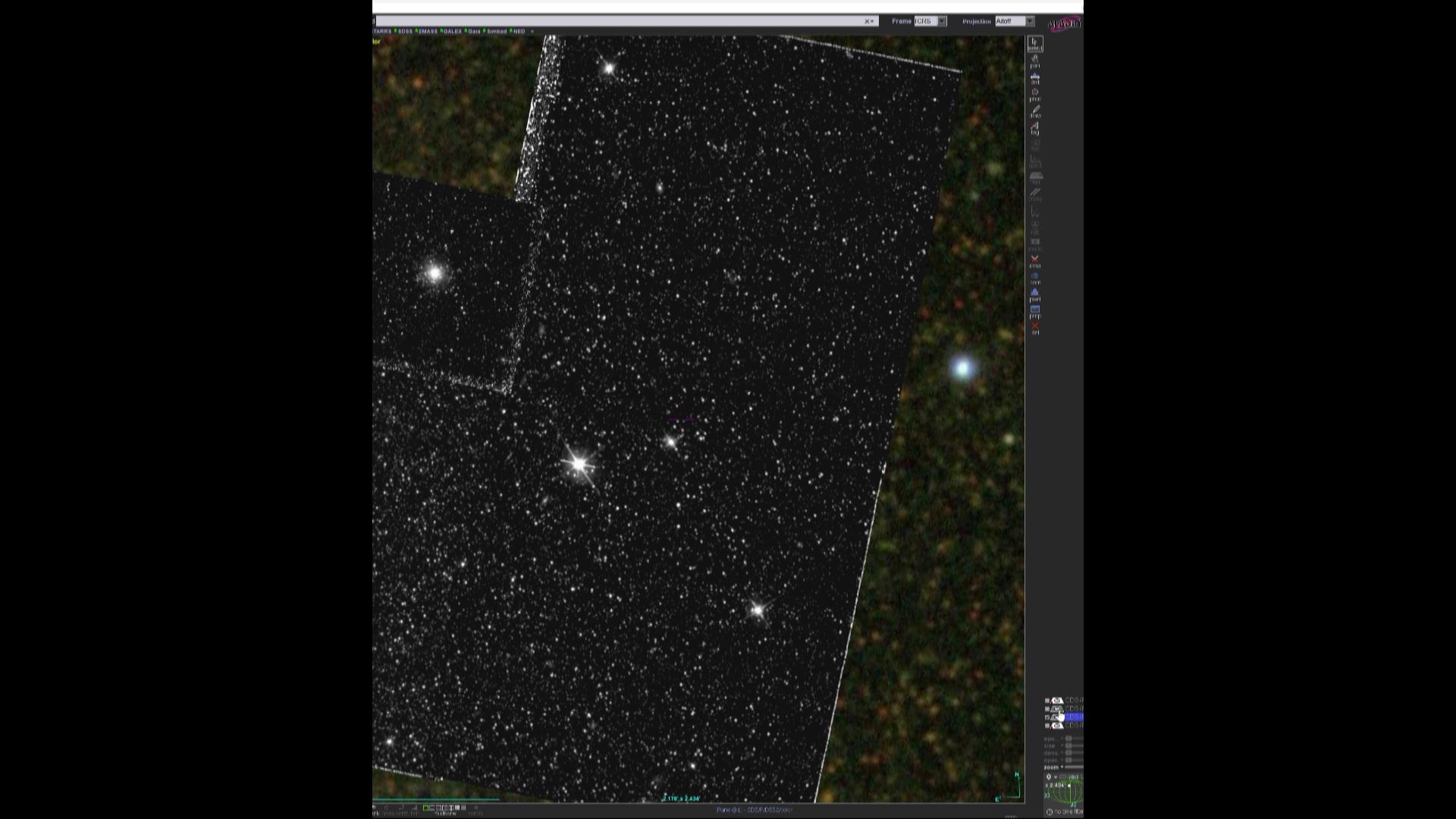
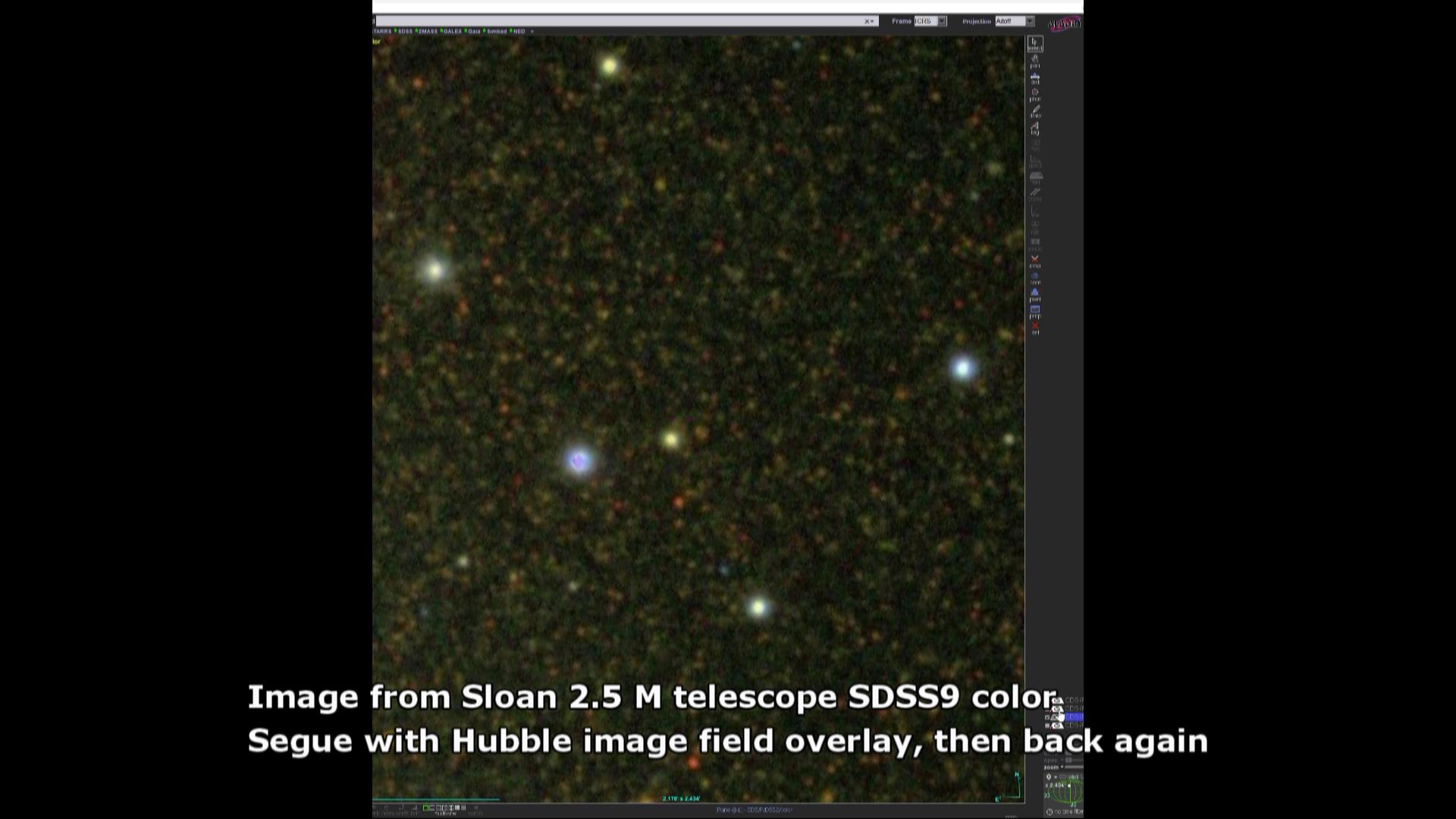
The first thing is a couple of frames from a video I made showing a blown up part of the field that I used to make my point. 1. It is in the outskirts of M110. 2. It is a bit limiting because it is in a still fairly crowded area, but it was the best field that also included data from the Hubble, which is pretty definitive in showing most of the field stars. 3. The video starts with data from the 2.5 meter Sloan digital survey scope in New Mexico. The SDSS9 data. It most closely resembles the sort of data that I have with the 14 inch RASA. These confirm that the rather granular Sloan data is a pretty faithful presentation of the starfield, it is just that the stars are rather large. This is interesting to see, because the Sloan and Hubble telescopes has essentially the same aperature. I cannot speak to all the differences that create such an advantage. Certainly there are many, including atmospheric (seeing), sensor, etc. See the following:📷 SnapShot(1).jpgSnapShot(1).jpg📷 SnapShot(2).jpgSnapShot(2).jpgA neat bonus here is the presence of a globular cluster at 10 o’clock, only proven with the Hubble image!
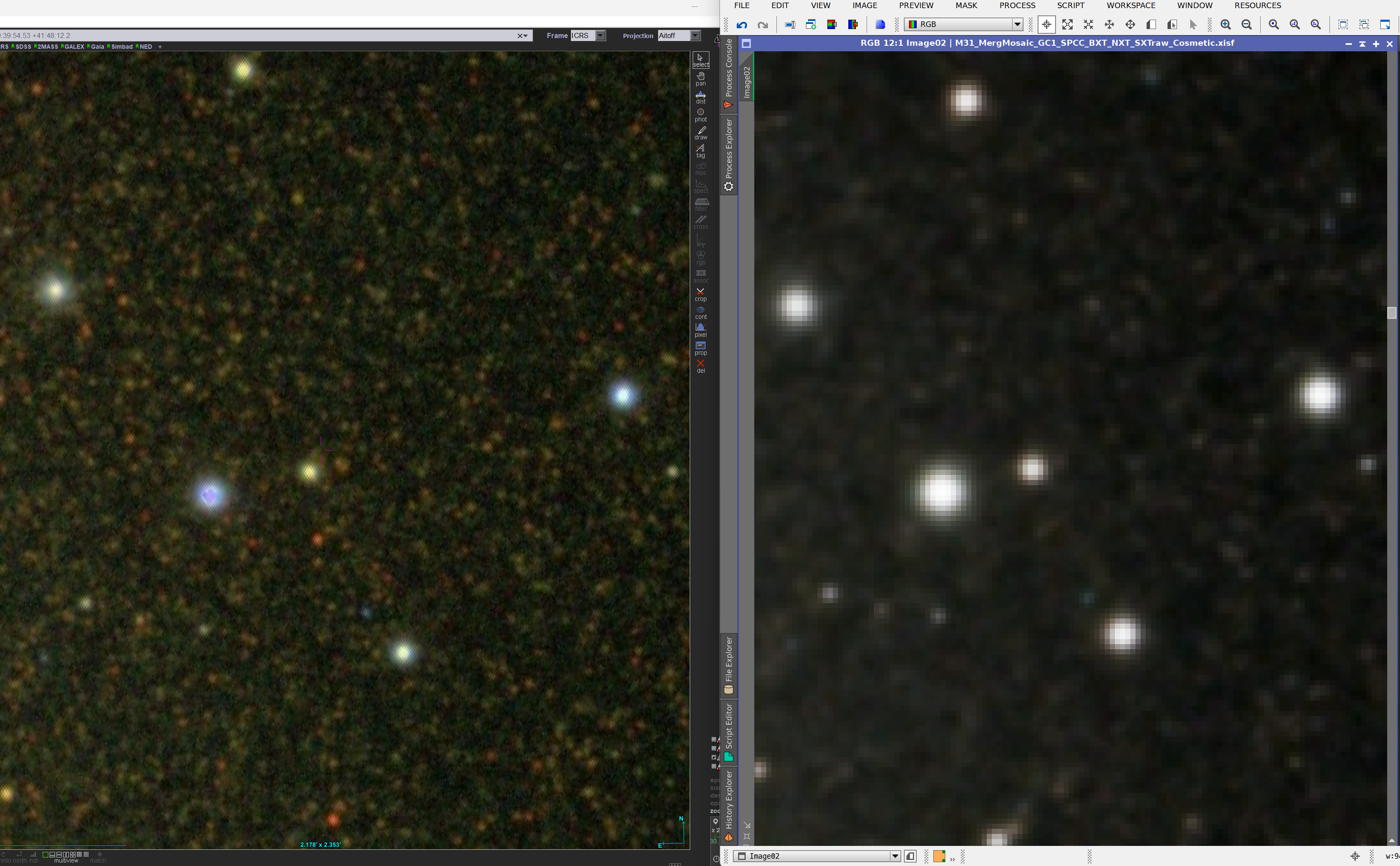
Once established that the rather coarse images seen in the SDSS9 data are directly correlated to stars seen in the Hubble image, below is the side-by-side comparison to the RASA 36 data. In this, and my comparisons with Hubble, it is clear that stars of the nature of the field stars are clearly visible in the RASA data. It may not be nearly as many as the SDSS9 image shows but a good number are seen. Short of that, the granularity that is seen in the RASA image, is not random at all, and most of the structures (like strings of stars, voids, and blurry representations) correlate very well with both the SDSS9 and even when I look back at the Hubble. I never stated that a 14 inch scope could rival a a 2.5 meter scope. I only stated that the granular nature of the RASA image left one with the impression that these galaxies are collections of stars and not some smooth light-emitting gradients or lit up gas. That is not something typically seen in the smaller optics that we normally use. But clearly here, the impression is achievable with an optic that falls within the bounds of amateur astronomy.

📷 M31 Comparison.pngM31 Comparison.pngTo support this idea of a galaxy being a collection of stars, I zoom out these views, leaving the view from above in the direct center of the fields for both data. See below:
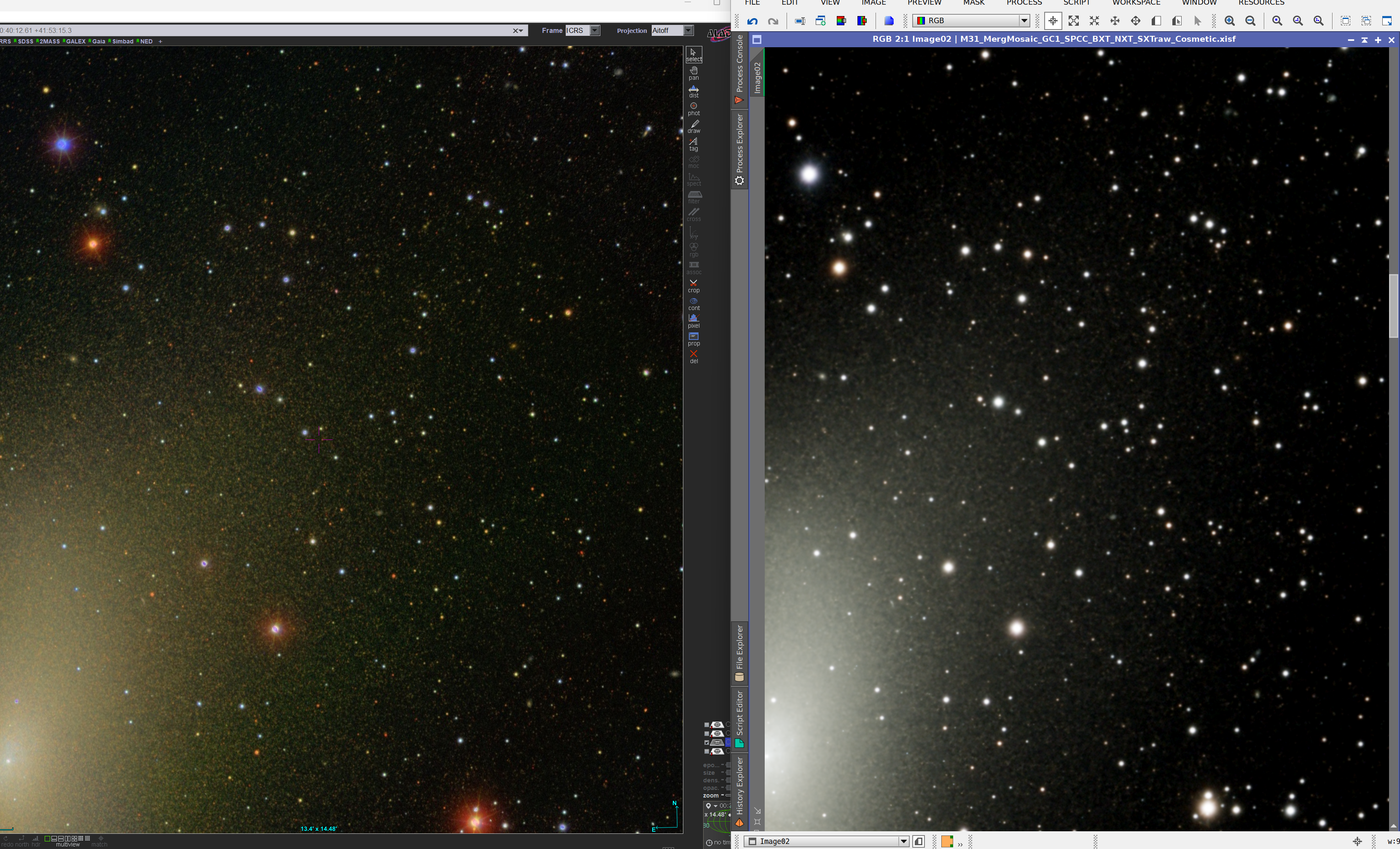
📷 M31 Comparison_Wide.pngM31 Comparison_Wide.pngYou can just barely see the core of M110 in the lower right of the images. Note, the more and more the resolution is improved in these two images and then finally the Hubble, the deeper and deeper one can see discrete stars, or at least discrete point light sources. The RASA being the worst, as one might expect.

So whats the problem that I had with this image? Well, because of this granularity, StarXTerminator actually removed most of these peripheral stars from my image! Hence the relevance to this conversation is if you are going to do this with data from a scope that can resolve stars from other galaxies, you better up your processing game considerably. Both of the processing ideas stated above and my process rely on StarXTerminator to work. However, the two ideas that were given in posts above has me thinking that I might just give this a try. I am thinking that this data will make or break those processing ideas.

Engaging
Tony Gondola avatar

The approach I took with my M33 image was to map the stars according to FWHM. The stars in the image that seemed to reflect the general morphology of the galaxy are the smallest and thus the faintest in the field. To just show those stars, all the stars in the field were sorted according to FWHM and those above a certain threshold were eliminated from the list. I believe the cut was at an FWHM of 2.5”. That list was then used to synthesize a star field which was screened back into a starless image. I’m sure I could have used the technique to make a mask for eliminating the bright stars but it’s close enough for proof of concept. The upside was that the stars were initially detected with the full image, not an extracted star plate. That process was only used to create the starless image to fold the stars back into.

Well written Helpful Insightful Respectful Engaging
Willem Jan Drijfhout avatar

@Alan Brunelle , I am intrigued by your comments about the granularity in galaxies like M110. About 1.5 years ago I published my own image of M110 and noticed such granularity. I thought originally it was a processing error (see the section at the bottom of the page labelled ‘Processing’), but while ruling out other sources for the effect, it appeared more and more convincing that the granularity was actual signal. Are you saying that this granularity is indeed real uneven light distribution due to an uneven light source (stars)? On purpose I’m using the term ‘light distribution’ here, as to get to the level of individual stars, one would assume that a significantly higher angular resolution would be needed.

And then it makes sense that this granularity is only seen in these close-by galaxies. A recent image that I took of M60 (57MLy) is just a blob of light without any granularity at all.

My images are taken with a CDK14 and an IMX455-based full-frame sensor.

Well written Respectful Engaging
Alan Brunelle avatar

Willem Jan Drijfhout · May 22, 2026, 06:16 PM

Are you saying that this granularity is indeed real uneven light distribution due to an uneven light source (stars)?

Willem, exactly! I like the way you word this. After all, for my data, any one “granule” can sometime be assigned to a single star, if ideally isolated, most often a granule is from a small local group of stars. Coincident patterns also prove the association to stars, or other small sources of light, such as small galaxies. So not really a true stellar resolution for the 14 inch scope. But the same can be said for the 2.5 M SDSS. But both images, viewed full frame is capable of making one step back and ponder the truth about what a galaxy is and what the relationship of the stars and star numbers to the overall galaxy is.

As far as what different optics can achieve, I think this analysis is interesting. That globular cluster that is resolved by the 2.5 M Hubble looks only like a star in the SDSS and even more so in the RASA data. It is likely that the Hubble would be able to resolve stars at a significantly greater distance. The RASA/camera combination here was at the perfect sampling for the system. So no more theoretical improvement to resolution wth dither/drizzle (not done) here. I cannot explain the difference seen between the SDSS and Hubble, other than seeing. However, it is clear that the Hubble image has a much finer pixel pitch than the SDSS image. So maybe a camera upgrade to the SDSS would help. However, we have to acknowledge that the SDSS is a survey instrument, imaged most of the sky, and maybe had little interest in splitting close stars!

Helpful Engaging Supportive
Alan Brunelle avatar

Willem Jan Drijfhout · May 22, 2026, 06:16 PM

I published my own image of M110

I am on the road so limited to viewing your image on my phone. Your image very much seems to catch the essence of this discussion.

If you can, pull up the SDSS9 images and do a close comparison between yours and their image.

Helpful Concise Supportive
Georg N. Nyman avatar

The SetiAstroSuite Pro offers an option to see a 3D display with all relevant information about the size and distance of your objects in an image. It is pretty interesting and you can see which parts of an image belong to a galaxy and which not. I would try it and see if it delivers what you want to get!

Helpful Respectful Concise Engaging Supportive
AnaTa avatar

SDSS is earth bound scope located in NM with no adaptive optic. It doesn’t come even close to Hubble regarding resolution. Its large size is mainly designed for high SNR, but not resolution. Actually, SDSS resolution will not be more than good 10-12” Newton or RC.

Clear Skies!

Helpful Concise Engaging
Alan Brunelle avatar

AnaTa · May 22, 2026, 08:47 PM

SDSS is earth bound scope located in NM with no adaptive optic. It doesn’t come even close to Hubble regarding resolution. Its large size is mainly designed for high SNR, but not resolution. Actually, SDSS resolution will not be more than good 10-12” Newton or RC.

Clear Skies!

The first points you make are consistent with what I understood. Can you be more clear about your last sentence? My source has the Sloan optic as a 2.5 meter optic. Are you saying that a 2.5 meter optic will be no better than a 10 inch? Have you seen the SDSS9 images? Clearly you must be referring to an earlier Sloan survey, of which there are a number. The SDSS9 images blow away just about anything I have seen posted by most anything on AstroBin

Engaging
AnaTa avatar

Seeing in NM, especially for SSDS scope location is not very good. Maybe 1.5”, I can max it with 10” scope. SSDS will be oversampling. Results will be similar.

Without adaptive optic, big scopes mainly work to get high SNR, which produces pleasing for eyes pictures.

Adaptive optic changes the game. Such scopes can match Hubble ST.

Clear Skies!

Tony Gondola avatar

AnaTa · May 23, 2026, 02:43 AM

Seeing in NM, especially for SSDS scope location is not very good. Maybe 1.5”, I can max it with 10” scope. SSDS will be oversampling. Results will be similar.

Without adaptive optic, big scopes mainly work to get high SNR, which produces pleasing for eyes pictures.

Adaptive optic changes the game. Such scopes can match Hubble ST.

Clear Skies!

Yes, the seeing generally in NM is poor but I’ve seen the SSDS up close. In fact, I used to have a few of the big aluminum plates that were drilled out for placement of fiber optic cables that would see an individual galaxy. The instrument is located in a very special place, at Apache Point. This is just down the road from the Sunspot Solar Observatory. This is home to the 1.6 meter Dunn vertical vacuum solar telescope. In it’s heyday it was considered one of the best solar telescopes in the world. I’ve looked through it and the image was stunning. This is also the location where I experienced my best view of Saturn, ever. It was like a photograph in a C8. The reason for placing the facility there is that it’s at the top of a 9000ft west facing vertical rise. The air flows over the desert and on up the rise in a highly laminar fashion, that’s what gives it such good seeing, probably some of the best seeing in the world.

Well written Helpful Insightful Respectful Engaging
Alan Brunelle avatar

AnaTa · May 23, 2026, 02:43 AM

Seeing in NM, especially for SSDS scope location is not very good. Maybe 1.5”, I can max it with 10” scope. SSDS will be oversampling. Results will be similar.

Without adaptive optic, big scopes mainly work to get high SNR, which produces pleasing for eyes pictures.

Adaptive optic changes the game. Such scopes can match Hubble ST.

Clear Skies!

Ok.

All your statements are presumptive and generalizations. You don't know what the seeing is or was at SDSS when these were done. You don't know how much data they reject before they accept data. I'm referring to data I have seen and have referenced and even shown in this thread. Please point to an image you may have from your 10 inch that rivals or beats the SDSS DR9 image. As I said, the latest images are much better than the earlier ones.

Very wide field telescopes can't really apply an artificial star-based adaptive optic like most large small field telescopes. Atmospheric aberration is too local for that to work. For instance, the LSST does not do so. It does have a sophisticated adaptive focus and large field adaption process, but it can't hope to correct every spot in the field independently using anything like a reference. I guess such is life in the survey area of research. Sloan also employed some similar stuff.

AnaTa avatar

Great! 10” RC scope will still match it. Without 2×2 binning, image scale is 0.38”/pixel. It can handle 0.6-0.8” seeing. This is exceptional seeing.

Helpful Concise Supportive
AnaTa avatar

No, it is not. I specifically tested them. It is long written. But, everything that I am telling is based on math, look Kolmogorov flow theory.

Alan Brunelle avatar

AnaTa · May 23, 2026, 03:27 AM

No, it is not. I specifically tested them. It is long written. But, everything that I am telling is based on math, look Kolmogorov flow theory.

So you calculated what the seeing was the night they took the data? Or only you know that the seeing in all of NM is never better than 1.5. And what Tony said about the site, you ignore? Your whole argument is based only on seeing and that is the one thing you can't possibly know anything about, no matter how big your calculator is. I won't respond to you again until you show me a concrete image from your ten inch that beats the SDSS DR9 in the region we are discussing here. If your ten inch beats the 2.5 M, then great. Leave your calculator out of it!

John Hayes avatar

Don Woelz · May 21, 2026, 04:42 PM

To image a star in M31, the closest galaxy to us, you would need a telescope capable of 0.1 to 0.3 arcsec resolution. You are probably not seeing individual stars, only clusters or bright reflection nebulae being illuminated by star clusters. And magnitude is not a measure of distance unless you know the intrinsic brightness of the star. The only star you are likely to see in a remote galaxy with most amateur equipment is a supernova.

Don,

That’s not quite correct. A few years ago, I read a paper by a physician in Portland, OR who used his 14” Celestron to repeat Hubble’s measurements of the famous 19th magnitude Cepheid variable star in M31. He then used his own measurements taken over about a year (as I recall) to compute an estimate of the distance to M31 that was quite close to the current accepted value. Amateurs with AAVSO have also made extensive measurements of this star. It’s a challenge but it can be done.

You are correct that most of the “stars” that you see in distant galaxies are clusters; however, it is possible to see some brighter individual stars in the closest galaxies. And…don’t forget that M31 is not the closest galaxy to the Milky Way. The large and small Magellanic clouds are satellite galaxies to the Milky Way that are at a distance of “only” about160,000 light-years (LMC) and 200,000 light-years (SMC)—far closer than M31.

John

Well written Helpful Concise Engaging
AnaTa avatar

Sometimes seeing is better than 1” in some of NM locations. However, seeing swings a lot. There is a notable exceptions: Pie Town and locations above 8000ft. There are several of them.

Alan Brunelle avatar

@Tony Gondola and any others interested in removing local stars from images of galaxies, etc. I wanted to point you to a book review that I just posted: https://app.astrobin.com/forum/topic/237637?post=304782&page=1

Not sure it is hung up in some kind of review process, so if it does not show up, check later.

The book is: Islands in Infinity: galaxies 3-D. Notably done by astronomers, one of whom happens to be Brian May, renown guitarist for Queen.

The reason I am alerting you to this book, is they came to the conclusion for their imagery to work, they would need to remove all stars attributed to the Milky Way. I cannot buy the book for you, but the process that is outlined in less than specific words, suggest the process they used was nearly identical to the one that I use. Though the reasons for the removal of stars was done through a statistical process, whatever that means! My statistical calculator is and has always been my brain, however, not trusting that piece of meat, I pause to often check my work with real data!

From what I am reading on this thread, I really like the idea of a mask generation process that uses GAIA data. I just wish that someone would just include the use of GAIA as a means for controlling their AI.

Helpful Engaging Supportive
Tony Gondola avatar

Alan Brunelle · May 24, 2026, 10:40 PM

@Tony Gondola and any others interested in removing local stars from images of galaxies, etc. I wanted to point you to a book review that I just posted: https://app.astrobin.com/forum/topic/237637?post=304782&page=1

Not sure it is hung up in some kind of review process, so if it does not show up, check later.

The book is: Islands in Infinity: galaxies 3-D. Notably done by astronomers, one of whom happens to be Brian May, renown guitarist for Queen.

The reason I am alerting you to this book, is they came to the conclusion for their imagery to work, they would need to remove all stars attributed to the Milky Way. I cannot buy the book for you, but the process that is outlined in less than specific words, suggest the process they used was nearly identical to the one that I use. Though the reasons for the removal of stars was done through a statistical process, whatever that means! My statistical calculator is and has always been my brain, however, not trusting that piece of meat, I pause to often check my work with real data!

From what I am reading on this thread, I really like the idea of a mask generation process that uses GAIA data. I just wish that someone would just include the use of GAIA as a means for controlling their AI.

The frustrating part is all the parts and data exist to make this possible. I just think that a lot of programmers are picking the low hanging fruit. I mean, do we really need another session planning app?