AstroBin is the home of astrophotography - Share full resolution images, preserve acquisition details, discover equipment, discuss techniques, and learn from the community.Discover AstroBin

Filter-induced halos?

sharkmelleyl.roulinJohn HayesTony Gondola
52 replies788 views
l.roulin avatar

Hi everyone,

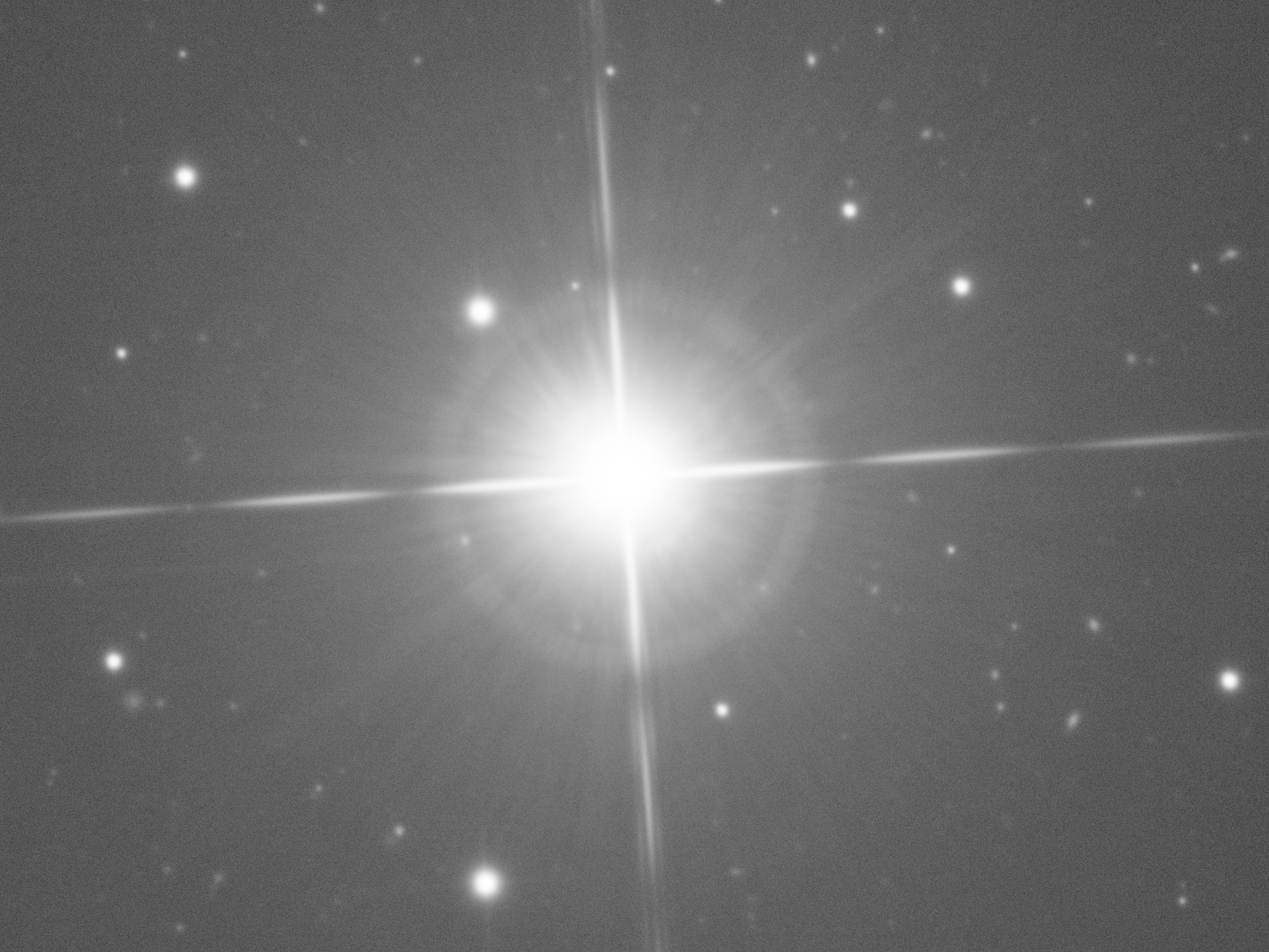
Every since I have started mono imaging, I have been plagued with prominent and large halos around (very) bright stars. See for yourselves on these LRGB stacks of LEO I, next to Regulus: Reflection.jpg

It appears to be especially noticeable in the green channel. Please note I cannot rule out dew and/or high clouds for the less sharp halos.

The images were captured using a 200 mm f4 newtonian with a Paracorr II, bringing the focal length to around 920 mm. Astronomik L2 and Deep Sky RGB were used in front of a ASI2600MM camera.

In order to try and diagnose the source of the reflections, I came acress this archived article from Astrodon, which describes a method to locate the reflection in the imaging train: https://web.archive.org/web/20140729003031/http://www.astrodon.com/articles_faq/articles_faq/press_release:391,355,49

In the green channel, I measured the halo to be approximately 1340 pixels wide, which ultimately leads me to a reflection distance of ~23 mm from the sensor. As per the article, this number has to be divided by 2 to get the physical distance, so ~11.5 mm. Accounting for the measurement errors, we get dangerously close from the distance between the front of the camera (without the tilt plate, which I removed) and the sensor itself.

I’m not really sure my method is sound, but would I be right to suspect the AR window of the camera, or its interaction with the filters? And, most importantly, is there anything I can do to resolve this issue, without resorting to buying new filters?

I would be very interested in hearing your opinions and any advice you would have.

Well written Helpful Insightful Respectful Engaging
andrea tasselli avatar

Possibly but given the large number of ASI2600MM out there and not many reports of large halos in green but not in luminance I suspect the Astronomik are to blame (my older Astronomik also did produce prominent halos in green). Even sub-par AR coatings perform well at the central wavelength in my experience.

Tony Gondola avatar

I agree, filters would be your prime suspect followed by the corrector followed by internal reflections. That said, this field really is an extreme test of your optical train.

Helpful Concise
sharkmelley avatar

You seem to be assuming that the problem exists within the camera because half the additional light path length causing the halo broadly matches the distance between the sensor and the camera window. But what is the distance between the filter and the camera window ? Is this also a match and so could filter reflections be the problem? Also what happens if you remove the Paracorr II?

Well written Concise Engaging
l.roulin avatar

Thank you all for your answers.

sharkmelley · Jul 15, 2026, 08:51 AM

You seem to be assuming that the problem exists within the camera because half the additional light path length causing the halo broadly matches the distance between the sensor and the camera window. But what is the distance between the filter and the camera window ? Is this also a match and so could filter reflections be the problem? Also what happens if you remove the Paracorr II?

Right, I didn’t think this distance could be found elsewhere and be a potential cause as well. I will need to take some measurements. I will also need to find a way to remove the Paracorr, as I am using a click-lock and need the 2” tube.

Respectful
Joey Conenna avatar
l.roulin avatar

Thanks Joey. It looks like I will have a chat with the retailer.

Some simple but not definitive diagnostic: I don’t get halos with my 2600 mc, no filters.

l.roulin avatar

Hi,

So I spoke with my retailer, who got me in touch with a representative of Astronomik. Based on a full-scale jpg of the green-filter image, he calculated that the distance of the problematic reflective glass was around 20 mm from the filter, and that it was flat and around 2 mm thick. He think the source of the reflection is the AR window of the camera - I crudely measured the distance between it and the filters to be ~21 mm.

He also said that “typical” AR coating are usually mediocre in the green part of the spectrum - this is not what the transmission curve from ZWO shows, on the contrary. Then, if there were known issues with the AR window of the ZWO cameras, surely people would talk about it, as it would not occur only with Astronomik filters. I did not find such claims. Additionally, it should be visible in the luminance, albeit washed out.

I’m a bit at a loss, here. It sure is possible that the AR window from my particular camera could be faulty. But does it necessarily rule out the Astronomik filters? The reflection is the result from an interaction between two surfaces that don’t play well together, so how can we say which is to blame?

According to Astronomik, I should try to replace that window. This is kind of an expensive test, to be honest, and the result is clearly not guaranteed.

What do you think?

Well written Engaging
andrea tasselli avatar

I have and have had many cameras by different manufacturers and many RGB filters too, astronomik included. None of them gave me halos other than astronomik.

sharkmelley avatar

l.roulin · Aug 23, 2026, 11:28 AM

What do you think?

If you have understood the Astronomik guy correctly then I think he has miscalculated. I agree that that the additional light path length caused by the reflection(s) is around 21mm for the the inner halo and 23mm for the outer halo. However he has forgotten to divide by 2 to give the distance between the 2 flat reflective surfaces.

So I reckon you need to search for 2 flat surfaces 10.5mm apart. Maybe this matches the distance between the sensor cover glass and the AR window of the camera. However, if the reflection is happening within the camera then it should still happen when the filter is removed but this is not your experience. You have measured 21mm between the filter and the AR window of the camera so that also rules out a reflection between the Astronomik filter and the AR window.

I don’t know about the Paracorr but as I suggested earlier, you try an experiment without the Paracorr to eliminate it from the enquiry.

Edit: Are you sure your measured distance of 21mm between the filter and the AR window of the camera is correct? For instance, if you are using a ZWO motorised filter wheel then the distance might measure around 10mm which would give good agreement for a reflection between the filter and the AR window.

Helpful Engaging
l.roulin avatar

Edit: Are you sure your measured distance of 21mm between the filter and the AR window of the camera is correct? For instance, if you are using a ZWO motorised filter wheel then the distance should measure around 10mm which would give good agreement for a reflection between the filter and the AR window.

Hi Shark,

Oops, you’re right, that was the distance right up to the sensor! My mistake…

So yes, we’re indeed at around 10 mm.

I would still need to try without the Paracorr, providing I find a way to mount my imaging train without it. I’ll have to look around in my spare-parts box. :) I brought it up with the guy from Astronomik, who told me the reflection was consistent with flat surfaces - the last lens from the Paracorr is curved.

Well written Respectful Concise Engaging
Tony Gondola avatar

l.roulin · Aug 23, 2026, 11:28 AM

Hi,

So I spoke with my retailer, who got me in touch with a representative of Astronomik. Based on a full-scale jpg of the green-filter image, he calculated that the distance of the problematic reflective glass was around 20 mm from the filter, and that it was flat and around 2 mm thick. He think the source of the reflection is the AR window of the camera - I crudely measured the distance between it and the filters to be ~21 mm.

He also said that “typical” AR coating are usually mediocre in the green part of the spectrum - this is not what the transmission curve from ZWO shows, on the contrary. Then, if there were known issues with the AR window of the ZWO cameras, surely people would talk about it, as it would not occur only with Astronomik filters. I did not find such claims. Additionally, it should be visible in the luminance, albeit washed out.

I’m a bit at a loss, here. It sure is possible that the AR window from my particular camera could be faulty. But does it necessarily rule out the Astronomik filters? The reflection is the result from an interaction between two surfaces that don’t play well together, so how can we say which is to blame?

According to Astronomik, I should try to replace that window. This is kind of an expensive test, to be honest, and the result is clearly not guaranteed.

What do you think?

I don’t think much of that. If the problem was the coating on the camera window you’d get halos with all your filters.

Concise
sharkmelley avatar

Is there any way you can slightly alter the distance of the filter from the camera, even by a millimetre? If that changes the size of the halo then it is pretty certain that the cause is a reflection between the filter and the AR camera window.

Well written Engaging
John Hayes avatar

Figuring out the source of stray light can be tricky. I have a similar halo problem with my system. Here is what I get around a bright star.

📷 Halo_Example.jpgHalo_Example.jpgI run an ASA600, which is an F/7 RC with a field flattener, Chroma filters, and a Moravian camera with a IMX455 sensor. I use an ONAG guider in my system but @Mark McComiskey runs exactly the same telescope with the same filters and sensor without an ONAG and he has exactly the same halos. So, we’ve ruled out the ONAG as a possible source of this problem. (The ONAG does introduce some minor strays but they are not colored halos that look like this.) I don’t have the optical prescription for the field flattener so I can’t ray trace it to see if it’s causing this problem. To test its effect, I made a special adapter so that I could remove the reducer from optical train. The strays didn’t change at all when I removed the flattener, so it is definitely not the cause.
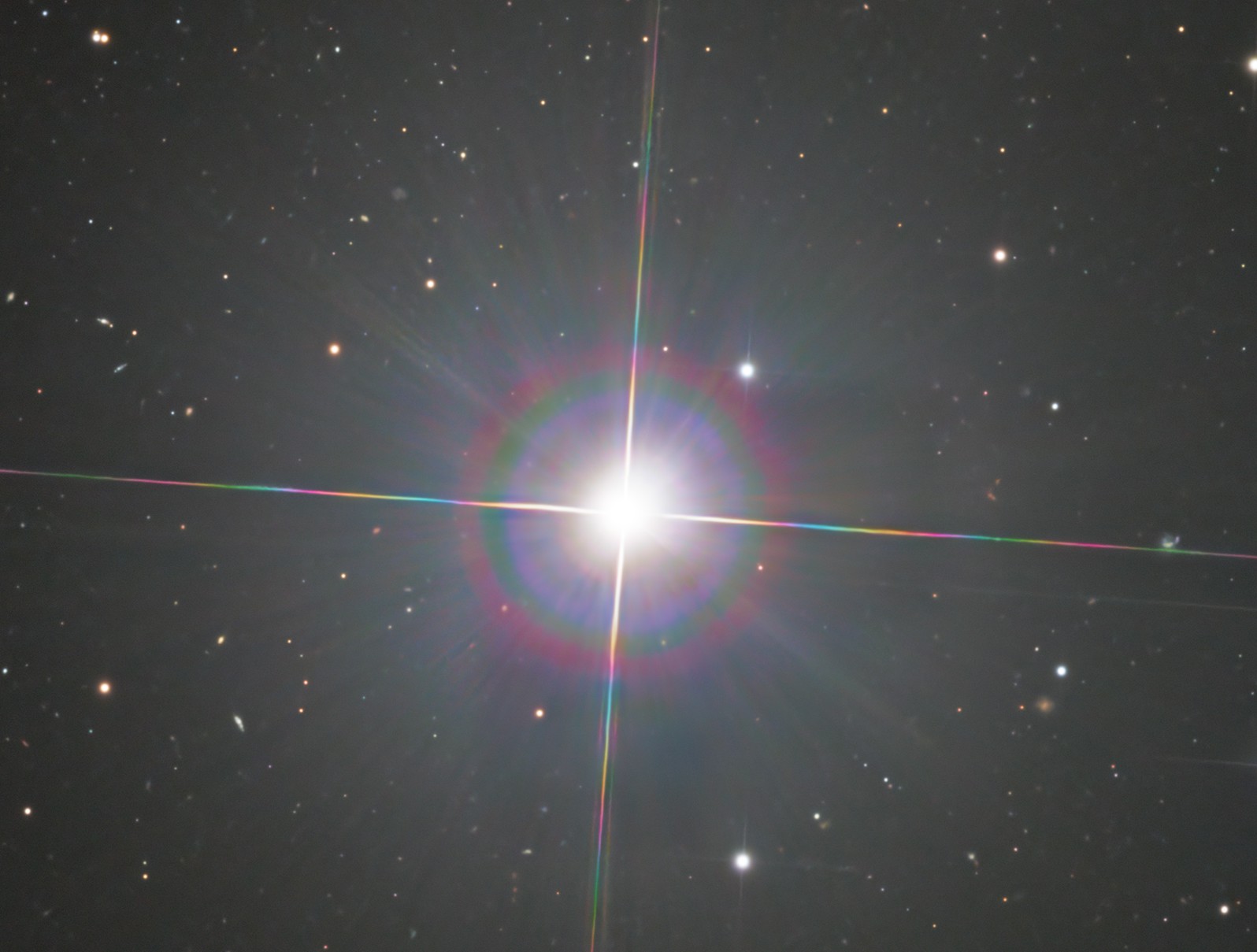
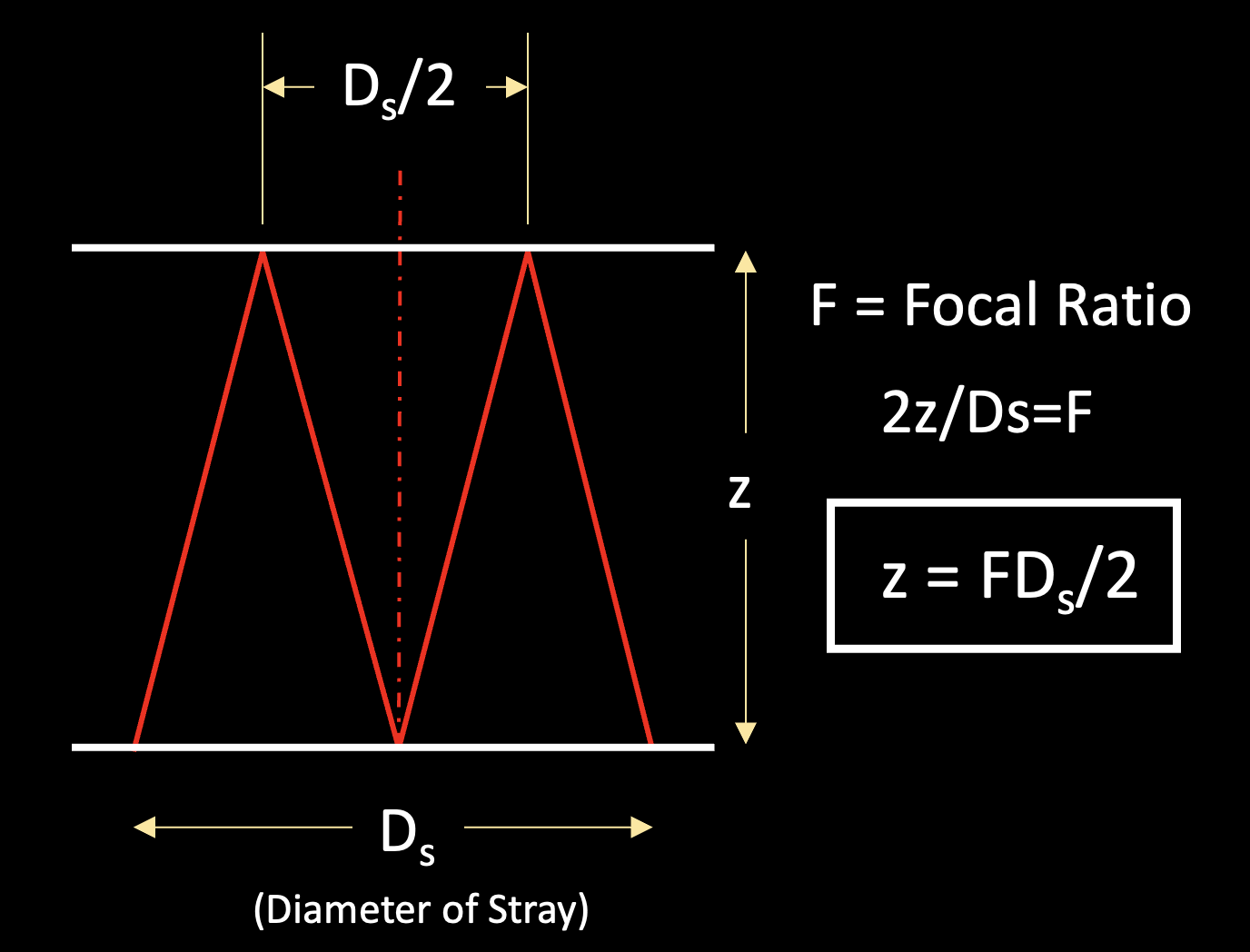
If I measure the size of the halos, I get 428 pixels (for the diameter of the outer red ring), which is 1.61 mm. Using the relationship shown below, that means that the reflecting surface must be 5.6 mm in front of the sensor surface, which has to be the camera window—if we assume that sensor is reflecting the light from the focused image. It certainly cannot be coming from a direct reflection from the filters.

📷 image.pngimage.pngNow for the mystery. Where are the colors coming from?? At first, I thought the colors might come from diffraction from the periodic rectangular structure in the sensor; however, if that were the case, the diffraction pattern would look like two crossed rectangular “Sinc” functions, which would not have circular symmetry. We could get colors if the light were coming from a stray reflection from the color filters but they sit much further from the sensor. I looked at a double bounce within the filter but with my spacings, that produces a stray that is much smaller than what I measure. So, I’m stumped.
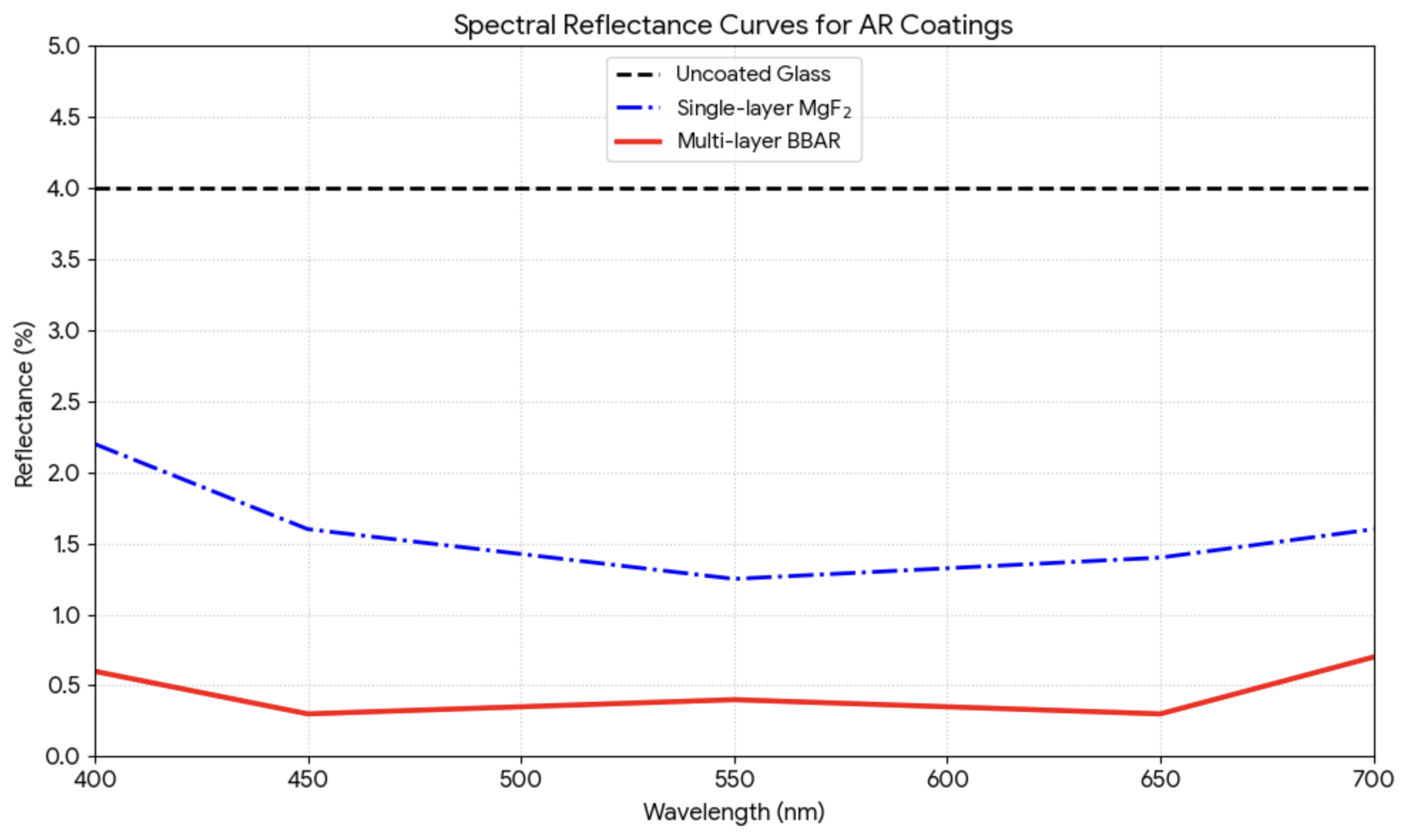
So, how do we get reflections from the camera window? As you know, bare glass has a reflectivity of about 4% in air. If you put a single ¼ wave layer of MgF2, you can cut the reflectivity by almost a third. If you use a higher quality, multi-layer broadband coating, you can get to about 0.5% reflectivity. The highest performance coatings can approach 0.2% - 0.25% reflectivity.

📷 image.png📷 image.pngimage.pngThe problem is that as the coatings become more sophisticated, making them perform well becomes increasingly more difficult. Little things like the ambient humidity can affect the performance of the coatings. Getting these coatings exactly right every single time in production is challenging. The result is that the optical performance can vary a fair amount between coating batches. So, without testing, some cameras may have windows that perform better than others.
I have a new camera on order to replace a camera on my refractor so I hope to try it on the ASA scope first to see if it works any better than the camera now on the scope. The idea is that perhaps the windows come from different coating batches and hence may have different AR properties. Mark and I currently have the same strays but @Wolfgang Promper , with the same scope and camera, doesn’t have the problem. The most likely source of the problem is the camera window but again, that doesn’t explain the colors!

Looking at the OP’s halos, my first impression is that they look too large to be coming from the camera window but of course that will vary with the focal ratio and the spacing. It would be helpful to know how far the sensor sits behind the window in that particular camera.

John

Well written Helpful Respectful Engaging
sharkmelley avatar

Wow, those coloured halos are wild. I can’t immediately think of a cause but I’ll give it some thought.

As for the OP’s ASI2600MM, ZWO’s published mechanical drawing shows the sensor to be 12.5mm behind the front face of the camera. The protective window is recessed from the front face of the camera and is 2mm thick, at least that’s the thickness of replacement protective windows from ZWO for the ASI2600MM. Unfortunately, we don’t know the depth of the recess.

However, a 2mm thick window would create a much bigger difference in the inner and outer halo diameters. The observed difference is better explained by a 1mm think substrate e.g. the Astronomik filter.

Well written Helpful Respectful Concise Engaging
John Hayes avatar

sharkmelley · Aug 23, 2026 at 11:33 PM

As for the OP’s ASI2600MM, ZWO’s published mechanical drawing shows the sensor to be 12.5mm behind the front face of the camera. The protective window is recessed from the front face of the camera and is 2mm thick, at least that’s the thickness of replacement protective windows from ZWO for the ASI2600MM. Unfortunately, we don’t know the depth of the recess.

That is certainly in the right ballpark for where the reflection appears to be coming from. It clearly can’t be coming from the filters.

John

John Hayes avatar

sharkmelley · Aug 23, 2026 at 11:33 PM

Wow, those coloured halos are wild. I can’t immediately think of a cause but I’ll give it some thought.

Mark,

Could the colors somehow be formed by the micro-lens array? It isn’t achromatic so could this be, a rainbow-like effect? In reflection, the lenses could be retro-reflecting the light like water drops in a rainbow so we are simply seeing the effects of dispersion in the glass. If that were the case, I would expect this to be a commonly observed effect and I don’t recall seeing very many others with this problem. On the other hand that might explain the circular symmetry.

John

Well written Respectful Concise Engaging
sharkmelley avatar

John Hayes · Aug 24, 2026, 01:24 AM

sharkmelley · Aug 23, 2026 at 11:33 PM

As for the OP’s ASI2600MM, ZWO’s published mechanical drawing shows the sensor to be 12.5mm behind the front face of the camera. The protective window is recessed from the front face of the camera and is 2mm thick, at least that’s the thickness of replacement protective windows from ZWO for the ASI2600MM. Unfortunately, we don’t know the depth of the recess.

That is certainly in the right ballpark for where the reflection appears to be coming from. It clearly can’t be coming from the filters.

I think the most likely explanation is a reflection between the filter and the camera’s protective window, since the distance between them is approx 10mm according to the OP’s measurement. This could be confirmed if the halo changes size with an altered spacing.

Well written Helpful Insightful Respectful Concise Engaging
sharkmelley avatar

John Hayes · Aug 24, 2026, 01:35 AM

sharkmelley · Aug 23, 2026 at 11:33 PM

Wow, those coloured halos are wild. I can’t immediately think of a cause but I’ll give it some thought.

Mark,

Could the colors somehow be formed by the micro-lens array? It isn’t achromatic so could this be, a rainbow-like effect?

Your blue, green and red halos are successively larger which suggests a wavelength dependence and invites some kind of diffraction/dispersion explanation. I can’t see how it could be caused by the micro-lens array but I’m wondering if similar effects could be found in the lens flares of terrestrial photography.

Edit: What happens to those halos as the star moves progressively off-axis?

Well written Respectful Concise Engaging
John Hayes avatar

sharkmelley · Aug 24, 2026 at 07:08 AM

John Hayes · Aug 24, 2026, 01:35 AM

sharkmelley · Aug 23, 2026 at 11:33 PM

Wow, those coloured halos are wild. I can’t immediately think of a cause but I’ll give it some thought.

Mark,

Could the colors somehow be formed by the micro-lens array? It isn’t achromatic so could this be, a rainbow-like effect?

Your blue, green and red halos are successively larger which suggests a wavelength dependence and invites some kind of diffraction/dispersion explanation. I can’t see how it could be caused by the micro-lens array but I’m wondering if similar effects could be found in the lens flares of terrestrial photography.

Edit: What happens to those halos as the star moves progressively off-axis?

Yes, there is a clear wavelength dependence. As far as I can tell, the halos are pretty shift independent throughout the field. The only requirement is to have a bright enough star to see the halos. As I said, Mark (McComiskey) and I both have the problem but Wolfgang (Promper) doesn’t so I believe that it’s related to the quality of the AR coatings on some component in the camera itself (like the micro lens array, the sensor, the window….or something else??). Hmm…come to think of it, I used to have a QHY600 on that scope so I’ll have to go back to see if it had displayed the problem. Adam Block runs a QHY600 on his scope and he has strays from the filters (which are MUCH larger) but not this problem, which again speaks to the problem being camera related. I’d love to understand it better but I’m most interested in getting rid of it!

John

Well written Helpful Insightful Respectful Engaging
l.roulin avatar

sharkmelley · Aug 23, 2026, 03:16 PM

Is there any way you can slightly alter the distance of the filter from the camera, even by a millimetre? If that changes the size of the halo then it is pretty certain that the cause is a reflection between the filter and the AR camera window.

Good idea, I can add the tilt plate (5-mm thick) back, it should make a pretty big difference. I will test this as soon as the sky clears up a bit.

For now, John and you seem to agree that the reflection can’t be coming from the filters, but probably from the window.

Thanks to all who responded, you gave me a way forward. :)

Well written Respectful Supportive
sharkmelley avatar

l.roulin · Aug 24, 2026, 06:12 PM

Good idea, I can add the tilt plate (5-mm thick) back, it should make a pretty big difference. I will test this as soon as the sky clears up a bit.

For now, John and you seem to agree that the reflection can’t be coming from the filters, but probably from the window.

On the contrary, I’m saying it’s not coming from the camera’s protective window because it’s 2mm thick, which does not agree with the difference in diameters of the inner and outer halo you are seeing.

I think the most likely explanation is a reflection between the filter and the camera’s protective window and that you will see a big increase in halo size if you add the tilt plate i.e. both the filter and the protective window are reflecting to a greater or lesser degree.

Well written Helpful Insightful Respectful Engaging
sharkmelley avatar

Hi John,

I find it difficult to see how the camera could cause your rainbow halos. In terrestrial photography various types of rainbow lens flares exist caused by internal reflections and scattering - caused by the lens and not the camera. Flaring is also well-known in astrophotography caused by grazing reflections of the light of stars outside (or inside) the image area and these are often rainbow coloured. I would first try to rule this out by imaging a bright star to reproduce the problem and use a sheet of black paper to successively obscure parts of the scope such as the edge of the front aperture, the edge of the primary mirror, the edge of the secondary, the edge of any baffles, the edge of any filter etc. Does this remove parts of the rainbow halo? If so, then you are well on your way to isolating the exact cause.

Mark

Well written Helpful Respectful Engaging Supportive
John Hayes avatar

sharkmelley · Aug 24, 2026 at 11:35 PM

Hi John,

I find it difficult to see how the camera could cause your rainbow halos. In terrestrial photography various types of rainbow lens flares exist caused by internal reflections and scattering - caused by the lens and not the camera. Flaring is also well-known in astrophotography caused by grazing reflections of the light of stars outside (or inside) the image area and these are often rainbow coloured. I would first try to rule this out by imaging a bright star to reproduce the problem and use a sheet of black paper to successively obscure parts of the scope such as the edge of the front aperture, the edge of the primary mirror, the edge of the secondary, the edge of any baffles, the edge of any filter etc. Does this remove parts of the rainbow halo? If so, then you are well on your way to isolating the exact cause.

Mark

Thanks for your thoughts Mark. First, I have to point out that this is completely different than terrestrial photography for one important reason. We are stretching the data to reveal information in the least significant bits of the data—to show the very faintest parts of the image. That’s where the interesting problems lie and it’s where any effects like this will be completely hidden when we look only at a linear image.

Remember, this isn’t coming from a refractive imaging system. Flare in a camera lens is normally caused by extreme off axis rays that get refracted in the lens elements to produce colors and then reflected (or diffracted) from some edge (like the edge of a lens) to get the light directed back onto the sensor. I’m not aware of any type of flare that manifest as a symmetric on-axis circle, which is what I’m seeing.

I’ve posted an image below showing the master red channel stretched with no other processing. As you can see, the halo is circular, fairly sharp, and well defined. The only refractive element in front of the camera is the field flattener and for a while I was completely convinced that it had to be the source of the problem. However, the problem did not go away when I removed it from the system, which blows that theory. Mark McComiskey had the same halos when he used a reducer on his scope, which is identical to mine. The halos didn’t change when he switched to the field flattener, which further strengthens the idea that the flattener is not the culprit.

That means that there are only two mirrors and a filter in front of the camera. I am certain that the diameter of the halo completely rules out the filter as the source. If I do a long exposure using my OIII filter on a very bright star, I can see the faint reflection from the filter—and it is the size that you would predict, which is MUCH larger than what am seeing here. So, I’m convinced that the filters are not a part of the problem. It is very hard to explain the colors but I think that the halos are being generated by the components in the camera itself. The only way I can think of testing that hypothesis is to swap cameras. I also am going to go flip through my older images taken with my QHY600M to see if I can find one with a bright star.

It’s a hard problem.

John

📷 image.pngimage.png

Well written Helpful Insightful Respectful Engaging
l.roulin avatar

sharkmelley · Aug 24, 2026, 09:23 PM

l.roulin · Aug 24, 2026, 06:12 PM

Good idea, I can add the tilt plate (5-mm thick) back, it should make a pretty big difference. I will test this as soon as the sky clears up a bit.

For now, John and you seem to agree that the reflection can’t be coming from the filters, but probably from the window.

On the contrary, I’m saying it’s not coming from the camera’s protective window because it’s 2mm thick, which does not agree with the difference in diameters of the inner and outer halo you are seeing.

I think the most likely explanation is a reflection between the filter and the camera’s protective window and that you will see a big increase in halo size if you add the tilt plate i.e. both the filter and the protective window are reflecting to a greater or lesser degree.

OK, I will run the test(s) and let you know. Hopefully we can isolate the problem. Depending on the results, do you think we will be able to determine if I have to swap the filters or the window? Or just that these two components can’t play well together?