
I was reprocessing an old image of M78 (in fact the only one I have published) which I took in the winter of 2004/2005 and decided to “colorize” it using a much more recent image taken in the winter of 2022/2023 of the same object (on a much larger FOV) taken with a smaller instrument. This one didn’t have the prerequisite to be pushed on AB but there more then enough to use for a LRGB composition. The image scales are comparable so I thought the matching would be an easy one (and much better than the original colour frames used back then). Lo and behold, PI isn’t playing ball, no matter what. This stuff happens when matching widely different instruments used with widely different imaging setups. So I registered manually the colour image to the luminance frame. Usually, once the first two matches are made, the rest follows easily enough. Not this time though. Further digging revealed that some of the stars in in the luminance frame were absent in the colour one and, oddly enough, few in the colour image weren’t there in the luminance frame either. Eventually I resorted to match only the brightest ones and obtained a reasonable match (a homomorphic transformation).
Side by side the most striking difference is in the upper left corner. The 2023 image show a bright patch essentially entirely absent in the 2004 image. Both images have been stretched in the same way.
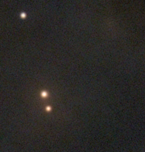
📷 image.png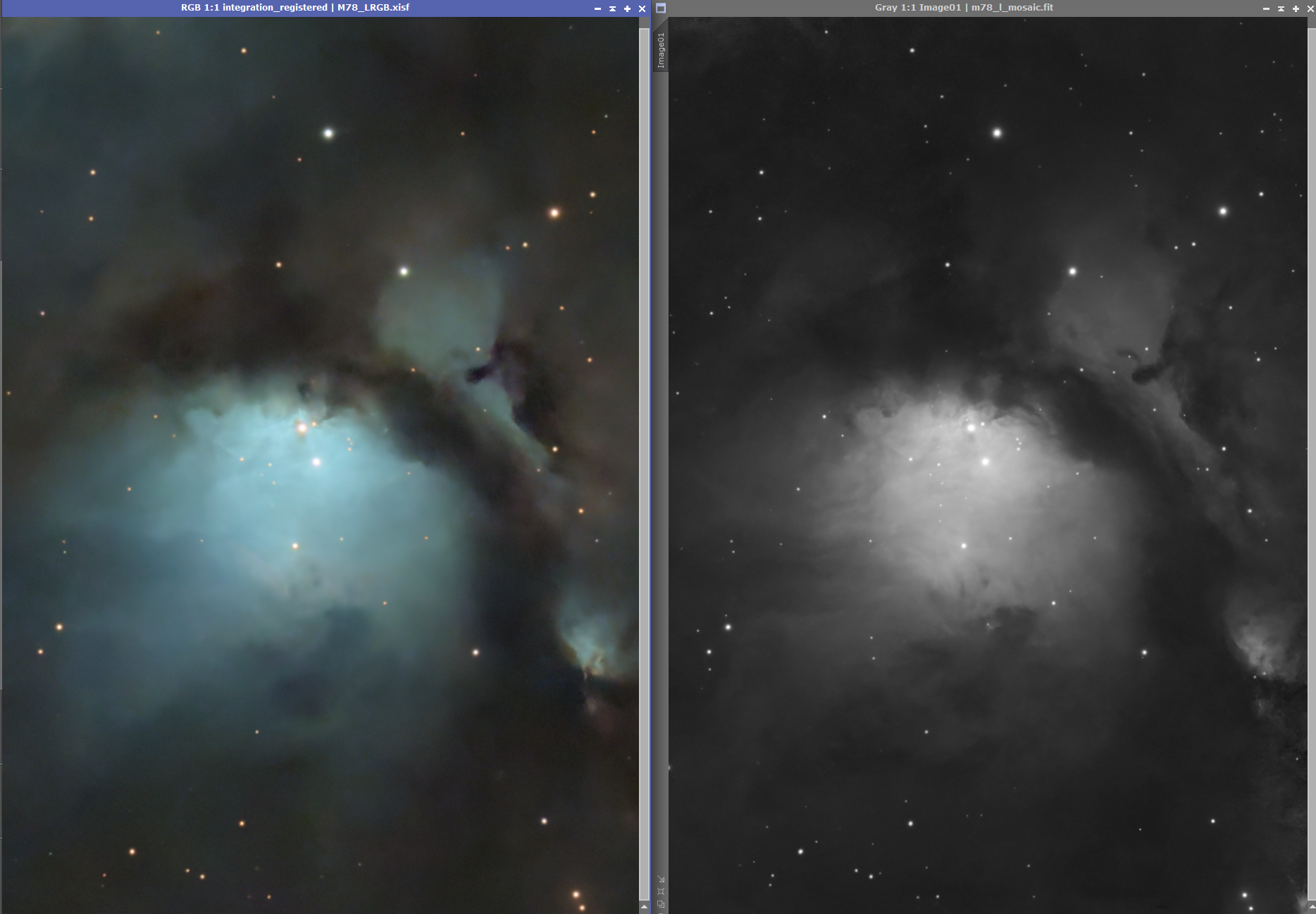 Furthermore, in the very lower right corner of the luminance there is another (part of) bright patch which is totally absent in the colour image (see below).
📷 image.png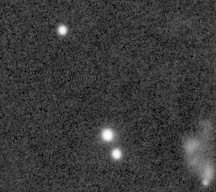 📷 image.png
 This in just few years, a nothing w.r.t. the galactic time period.
