AstroBin is the home of astrophotography - Share full resolution images, preserve acquisition details, discover equipment, discuss techniques, and learn from the community.Discover AstroBin

Astronomik 4 nm NB filters (released January 2026) vs. Antlia 3 nm

16 replies181 views
lumendo avatar

Does anyone have experience with (or informed thoughts on) the new Astronomik 4 nm filters (released January 2026)? Astronomik claims “no halos” on their website:
https://www.astronomik.com/en/Narrowband-Filters/4nm-Filters/

I am currently deciding between the following options for my first SHO filter set:

  • Variant 1: S+H+O: ANTLIA 3 nm 2”

  • Variant 2: S+H: ANTLIA 3 nm 2” + O: Chroma 3 nm 2”

  • Variant 3: S+H+O: Astronomik 4 nm 2”

My typical focal ratio is f/4.9. Sometimes as bright as f/3.5. I am living under a Bortle 4.7 sky. Regarding variant 2: I don’t plan to use an OAG any time soon. So having SHO filters with different thickness should not be a problem.

My two main concerns are:

  • Halos that are hard to correct in post

  • Worse signal to noise with 4 nm vs. 3 nm

Well written Respectful Concise Engaging
Lynn K avatar

Are you asking about the Astromnomik “MFR" 4nm narrow band filter good down to F4.5 FL? I have the HA & OIII, but have not used them enought to evaluate. I have use the MaxFR Ha & OIII on a Tak FSQ106ED at F3.6 and a Officina Stellare RH200 at F3. There were no halos with those. Others have made similar claimes. I personaly have faith in Astronomik QE to full field its claimes. I only have a Antlia RGB narrow band OSC filter , but have not had an opportunity to use it.

The MaxFR 4nm filter have not been released.

Lynn K.

Tony Gondola avatar

A 3 nm filter is going to give you considerable light loss at F/3.5, so much so it really negates the reason to even be at F/3.5

Well written Concise
andrea tasselli avatar

How do you know? Did you test them and with the OP’s gear too? Besides the disputable thinking of equating FR to SNR…

lumendo avatar

Tony Gondola · Sep 19, 2026, 05:31 PM

A 3 nm filter is going to give you considerable light loss at F/3.5, so much so it really negates the reason to even be at F/3.5

On the ANTLIA website they state: “Blue shift data shows that Antlia 3nm Pro filters can be used with nearly all systems as fast as f/3 with minimal loss in emission signal and meets the requirements of fast optics.”

http://www.antliafilter.com/pd.jsp?fromColId=137&id=67#_pp=137_607

What is your opinion on that?

Well written Respectful
lumendo avatar

Lynn K · Sep 19, 2026, 04:57 PM

Are you asking about the Astromnomik “MFR" 4nm narrow band filter good down to F4.5 FL? I have the HA & OIII, but have not used them enought to evaluate. I have use the MaxFR Ha & OIII on a Tak FSQ106ED at F3.6 and a Officina Stellare RH200 at F3. There were no halos with those. Others have made similar claimes. I personaly have faith in Astronomik QE to full field its claimes. I only have a Antlia RGB narrow band OSC filter , but have not had an opportunity to use it.

The MaxFR 4nm filter have not been released.

Lynn K.

Yes, I am referring tho the 2 nm MFR filters. I just saw that Astronomik states that they can be used with f/4.5 or slower. https://www.astronomik.com/en/Astronomik-OIII-4nm-2-M48/10206200

The 4nm MaxFR are probably the ones I would need for maximum SNR. But as you said, they are not yet released. I wonder how they realize the compatiblity with faster f- ratios. They state “Unlike other manufacturers' filters, which often require special “High-Speed” versions, Astronomik’s MaxFR filters maintain their transmission characteristics even with normal optical systems.”. (https://www.astronomik.com/en/Narrowband-Filters/MaxFR-Filters/) This sounds like they don’t just slightly blue shift the transmission window.

Did you youse the MaxFR 6 nm version?

Concise
Tony Gondola avatar

I calculated the offset. I can’t take the time to look up the curves for all the filters mentions and plot the shifts. What I’ve calculated is based on the stated bandpass of the filters, the stated geometeric F ratio and a generous guess as to the refractive index of the glass. For instance, I for Ha I get a fequency shift of 1.64 nm. That gives a transmission loss of more than 50% with the 3nm Antila filter. What number do you get?

Concise
Tony Gondola avatar

Dominik Floess · Sep 19, 2026, 06:08 PM

Tony Gondola · Sep 19, 2026, 05:31 PM

A 3 nm filter is going to give you considerable light loss at F/3.5, so much so it really negates the reason to even be at F/3.5

On the ANTLIA website they state: “Blue shift data shows that Antlia 3nm Pro filters can be used with nearly all systems as fast as f/3 with minimal loss in emission signal and meets the requirements of fast optics.”

http://www.antliafilter.com/pd.jsp?fromColId=137&id=67#_pp=137_607

What is your opinion on that?

I guess you can test that for yourself. Grab the plot for the filter and plot a line at 654.6 nm. That’s the position of the Ha line in an F/3.5 light cone.

Tony Gondola avatar

If anyone wants to dig into the fast optics, filter bandpass question, you might enjoy this write up by Jim Thompson:

http://karmalimbo.com/aro/reports/Article%20-%20Narrowband%20Filters%20&%20Fast%20Optics_Nov2020.pdf

andrea tasselli avatar

Tony Gondola · Sep 19, 2026, 06:17 PM

I calculated the offset. I can’t take the time to look up the curves for all the filters mentions and plot the shifts. What I’ve calculated is based on the stated bandpass of the filters, the stated geometeric F ratio and a generous guess as to the refractive index of the glass. For instance, I for Ha I get a fequency shift of 1.64 nm. That gives a transmission loss of more than 50% with the 3nm Anila filter. What number do you get?

Assuming it’s me you’re replaying to, did you calculate the integral over all the FRs weighted against the relative areas? Because if you didn’t you didn’t get the right answer. My calculation for the filter in question (here Ha) is that the effect is 8% transmission loss.

lumendo avatar

Tony Gondola · Sep 19, 2026, 06:22 PM

Dominik Floess · Sep 19, 2026, 06:08 PM

Tony Gondola · Sep 19, 2026, 05:31 PM

A 3 nm filter is going to give you considerable light loss at F/3.5, so much so it really negates the reason to even be at F/3.5

On the ANTLIA website they state: “Blue shift data shows that Antlia 3nm Pro filters can be used with nearly all systems as fast as f/3 with minimal loss in emission signal and meets the requirements of fast optics.”

http://www.antliafilter.com/pd.jsp?fromColId=137&id=67#_pp=137_607

What is your opinion on that?

I guess you can test that for yourself. Grab the plot for the filter and plot a line at 654.6 nm. That’s the position of the Ha line in an F/3.5 light cone.

Tony Gondola · Sep 19, 2026, 07:35 PM

Dominik Floess · Sep 19, 2026, 06:55 PM

Tony Gondola · Sep 19, 2026, 06:22 PM

Dominik Floess · Sep 19, 2026, 06:08 PM

Tony Gondola · Sep 19, 2026, 05:31 PM

A 3 nm filter is going to give you considerable light loss at F/3.5, so much so it really negates the reason to even be at F/3.5

On the ANTLIA website they state: “Blue shift data shows that Antlia 3nm Pro filters can be used with nearly all systems as fast as f/3 with minimal loss in emission signal and meets the requirements of fast optics.”

http://www.antliafilter.com/pd.jsp?fromColId=137&id=67#_pp=137_607

What is your opinion on that?

I guess you can test that for yourself. Grab the plot for the filter and plot a line at 654.6 nm. That’s the position of the Ha line in an F/3.5 light cone.

📷 image.pngSo the rays with the largest angle of incidence have ~70% of light tramsmission. All the other light rays have a smaller AOI and thus higher transmission. So if I neglect any fabrication tolerance on the central wavelength of the transmission window, there seems to be still some significant light gathering benefit of f/3.5 over f/4.9. Although, as you mentioned, I would not get the full amount of light potentially available by f/3.5.

I might be wrong but I belive most of the energy is coming from the outer area of the apature, where most of the area is. I belive the write up I posted the link to talks about that. As you go further off ideal frequency it’s like a reduction in apature in terms of radience because the steeper rays are attenuated the most.

Tony Gondola · Sep 19, 2026, 07:35 PM

Dominik Floess · Sep 19, 2026, 06:55 PM

Tony Gondola · Sep 19, 2026, 06:22 PM

Dominik Floess · Sep 19, 2026, 06:08 PM

Tony Gondola · Sep 19, 2026, 05:31 PM

A 3 nm filter is going to give you considerable light loss at F/3.5, so much so it really negates the reason to even be at F/3.5

On the ANTLIA website they state: “Blue shift data shows that Antlia 3nm Pro filters can be used with nearly all systems as fast as f/3 with minimal loss in emission signal and meets the requirements of fast optics.”

http://www.antliafilter.com/pd.jsp?fromColId=137&id=67#_pp=137_607

What is your opinion on that?

I guess you can test that for yourself. Grab the plot for the filter and plot a line at 654.6 nm. That’s the position of the Ha line in an F/3.5 light cone.

📷 image.pngSo the rays with the largest angle of incidence have ~70% of light tramsmission. All the other light rays have a smaller AOI and thus higher transmission. So if I neglect any fabrication tolerance on the central wavelength of the transmission window, there seems to be still some significant light gathering benefit of f/3.5 over f/4.9. Although, as you mentioned, I would not get the full amount of light potentially available by f/3.5.

I might be wrong but I belive most of the energy is coming from the outer area of the apature, where most of the area is. I belive the write up I posted the link to talks about that. As you go further off ideal frequency it’s like a reduction in apature in terms of radience because the steeper rays are attenuated the most.

I had to remove the graph in my last post as I found out that the transmission spectrum I shared might actuall not be correct. It is surprisingly hard to find an official spectrum for the antlia 3 nm H-alpha. However, I understand your reasoning behind the wavelength shift and the transmission loss.

Concise
Tony Gondola avatar

andrea tasselli · Sep 19, 2026, 06:48 PM

Tony Gondola · Sep 19, 2026, 06:17 PM

I calculated the offset. I can’t take the time to look up the curves for all the filters mentions and plot the shifts. What I’ve calculated is based on the stated bandpass of the filters, the stated geometeric F ratio and a generous guess as to the refractive index of the glass. For instance, I for Ha I get a fequency shift of 1.64 nm. That gives a transmission loss of more than 50% with the 3nm Anila filter. What number do you get?

Assuming it’s me you’re replaying to, did you calculate the integral over all the FRs weighted against the relative areas? Because if you didn’t you didn’t get the right answer. My calculation for the filter in question (here Ha) is that the effect is 8% transmission loss.

What was your result for the shift in nanometers?

Tony Gondola avatar

Dominik Floess · Sep 19, 2026, 06:55 PM

Tony Gondola · Sep 19, 2026, 06:22 PM

Dominik Floess · Sep 19, 2026, 06:08 PM

Tony Gondola · Sep 19, 2026, 05:31 PM

A 3 nm filter is going to give you considerable light loss at F/3.5, so much so it really negates the reason to even be at F/3.5

On the ANTLIA website they state: “Blue shift data shows that Antlia 3nm Pro filters can be used with nearly all systems as fast as f/3 with minimal loss in emission signal and meets the requirements of fast optics.”

http://www.antliafilter.com/pd.jsp?fromColId=137&id=67#_pp=137_607

What is your opinion on that?

I guess you can test that for yourself. Grab the plot for the filter and plot a line at 654.6 nm. That’s the position of the Ha line in an F/3.5 light cone.

📷 image.pngSo the rays with the largest angle of incidence have ~70% of light tramsmission. All the other light rays have a smaller AOI and thus higher transmission. So if I neglect any fabrication tolerance on the central wavelength of the transmission window, there seems to be still some significant light gathering benefit of f/3.5 over f/4.9. Although, as you mentioned, I would not get the full amount of light potentially available by f/3.5.

I might be wrong but I belive most of the energy is coming from the outer area of the apature, where most of the area is. I belive the write up I posted the link to talks about that. As you go further off ideal frequency it’s like a reduction in apature in terms of radience because the steeper rays are attenuated the most. Adding a central obstruction makes it worse.

lumendo avatar

I will mostly capture with f/4.9. So transmission loss should be OK.

Most concerning to me is the formation of halos that are difficult to correct in post. Which of the three variants ist most sensible?

  • Variant 1: S+H+O: ANTLIA 3 nm 2”

  • Variant 2: S+H: ANTLIA 3 nm 2” + O: Chroma 3 nm 2”

  • Variant 3: S+H+O: Astronomik 4 nm 2”

Concise
lumendo avatar

Tony Gondola · Sep 19, 2026, 07:35 PM

Dominik Floess · Sep 19, 2026, 06:55 PM

Tony Gondola · Sep 19, 2026, 06:22 PM

Dominik Floess · Sep 19, 2026, 06:08 PM

Tony Gondola · Sep 19, 2026, 05:31 PM

A 3 nm filter is going to give you considerable light loss at F/3.5, so much so it really negates the reason to even be at F/3.5

On the ANTLIA website they state: “Blue shift data shows that Antlia 3nm Pro filters can be used with nearly all systems as fast as f/3 with minimal loss in emission signal and meets the requirements of fast optics.”

http://www.antliafilter.com/pd.jsp?fromColId=137&id=67#_pp=137_607

What is your opinion on that?

I guess you can test that for yourself. Grab the plot for the filter and plot a line at 654.6 nm. That’s the position of the Ha line in an F/3.5 light cone.

📷 image.pngSo the rays with the largest angle of incidence have ~70% of light tramsmission. All the other light rays have a smaller AOI and thus higher transmission. So if I neglect any fabrication tolerance on the central wavelength of the transmission window, there seems to be still some significant light gathering benefit of f/3.5 over f/4.9. Although, as you mentioned, I would not get the full amount of light potentially available by f/3.5.

I might be wrong but I belive most of the energy is coming from the outer area of the apature, where most of the area is. I belive the write up I posted the link to talks about that. As you go further off ideal frequency it’s like a reduction in apature in terms of radience because the steeper rays are attenuated the most. Adding a central obstruction makes it worse.

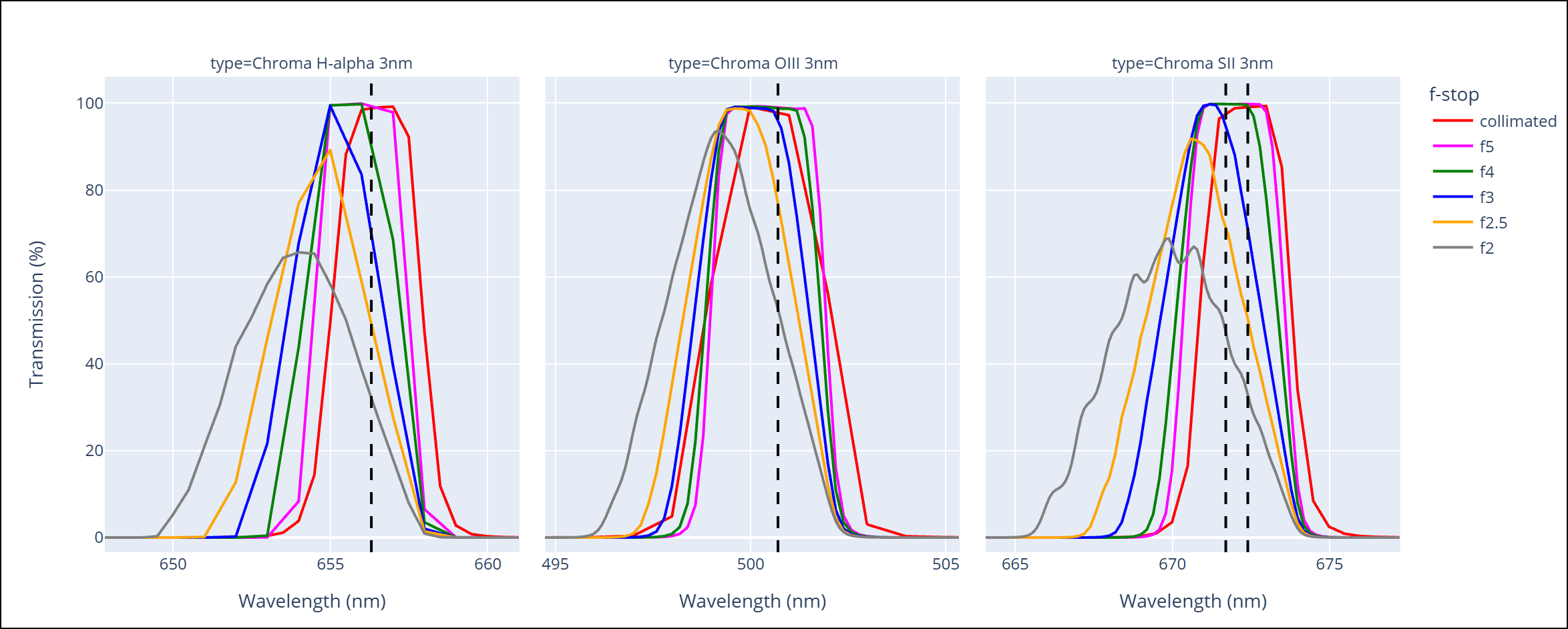
Chroma shares CSV files for the transmission data of their 3 nm filters and different focal ratios (https://www.chroma.com/products/sets/27106-sii-ha-oiii-3nm/). I plotted them in the following graph:
📷 image.pngimage.pngI assume they calculate the effective transmission over the full bundle of light rays. These filters appear to produce almost no transmission loss for telescopes as fast as f4. For f/3 the effective transmission goes down to ~70% for Ha and SII but stays higher for OIII.
I would really like to see such a graph for antlia 3 nm filters.

Well written Helpful Respectful Concise Engaging
Ralf Dinkelmeyer avatar

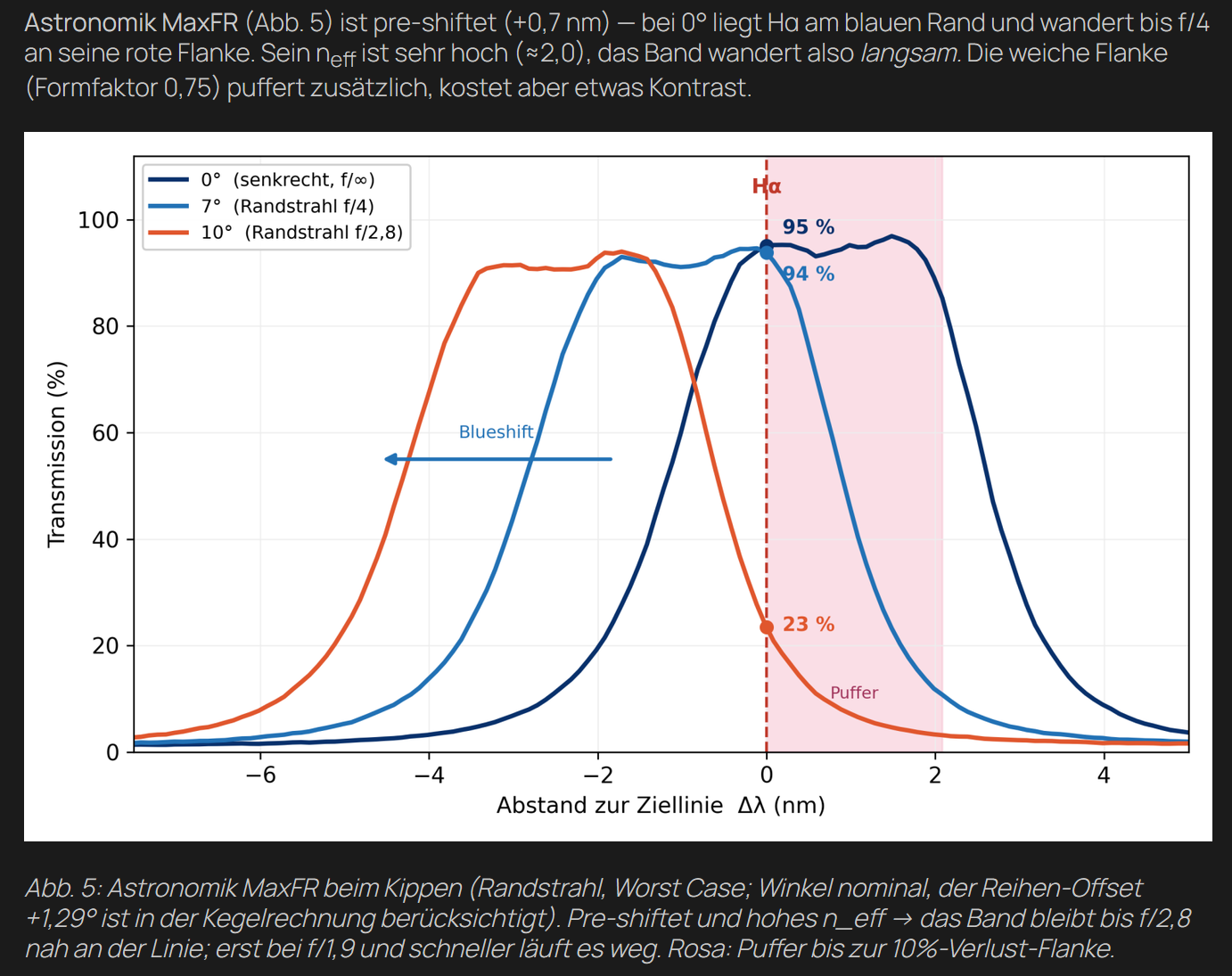
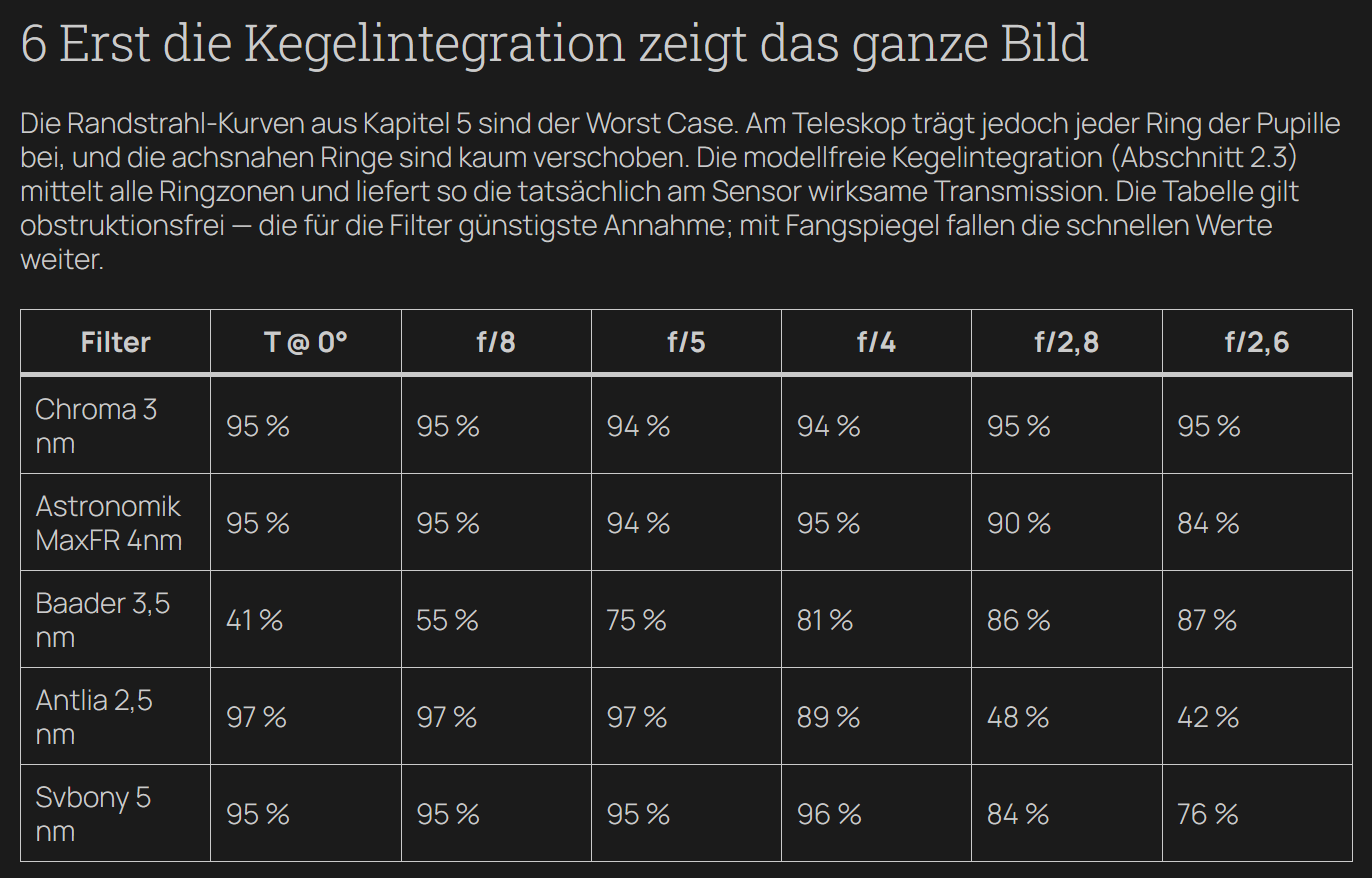
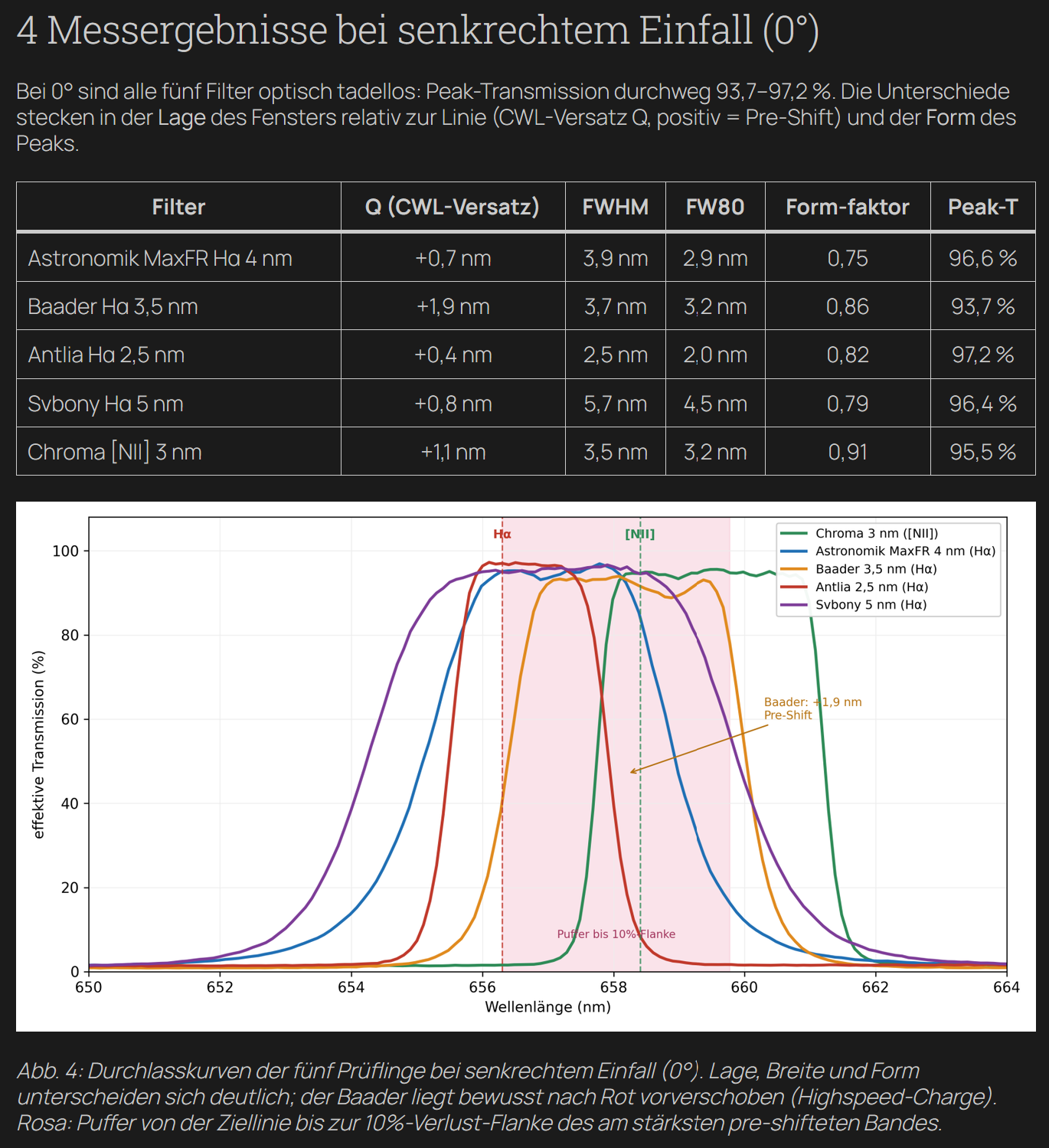
I have measured those filters with my highresolution spectrometer: spica-observatory.de/astrofotografie/schmalbandfilter-im-schnellen-strahlengang-monobandfilter-am-hα-band/

📷 grafik.pnggrafik.png📷 grafik.pnggrafik.png📷 grafik.pnggrafik.png

Brian avatar

Hi @Ralf Dinkelmeyer

you tested the Astronomik maxFR 4mn in your Artikel on your website.
But where you bought the filter?

On the Astronomik webpage it says “4nm filters with MaxFR coating are currently in development”.
It seems that you can only buy the normal MFR series at the moment.
Or did you get the filters for testing from Gerd?

The filters are looking quiet interesting 😄

Greetings from Germany
Brian

Respectful